Transfer Protocol: Range to Course
The 50-Rep Daily Blueprint ends with Play It—but that label alone does not explain when a pattern is installed, when to stop calibrating, or how reps survive the first tee. Transfer Protocol closes the gap between block practice on the range and execution under pressure.
Learn It builds the pattern. Prove It and Play It stress-test it on the range; this protocol proves it travels on course.
Graduation rules and exit criteria live here. How to structure random sessions, pressure games, and surface rotation live in Course Management & Transfer. Tactical decisions on course (landing spots, lies) live in On-Course Tactics.
Hitting 50 perfect reps at one target with one club proves block competence—not course readiness. Patterns that never face random targets, new lies, or a full pre-shot routine revert the moment context changes.
The Three Practice Modes
Final Boss Golf progresses through three modes. Each mode has a different success metric.
| Mode | Objective | Success metric | When to use |
|---|---|---|---|
| Block | Install geometry | Constraint cleared; delivery rule held | Learn It–Prove It of 50-Rep; new pattern |
| Random | Stress-test under variation | Pattern holds across clubs, targets, lies | Play It; pattern stable in block |
| On-course | Score under context | Pre-shot routine intact; fault does not return | After random-mode exit criteria met |
Block teaches what to do. Random teaches whenever. On-course proves why it matters.
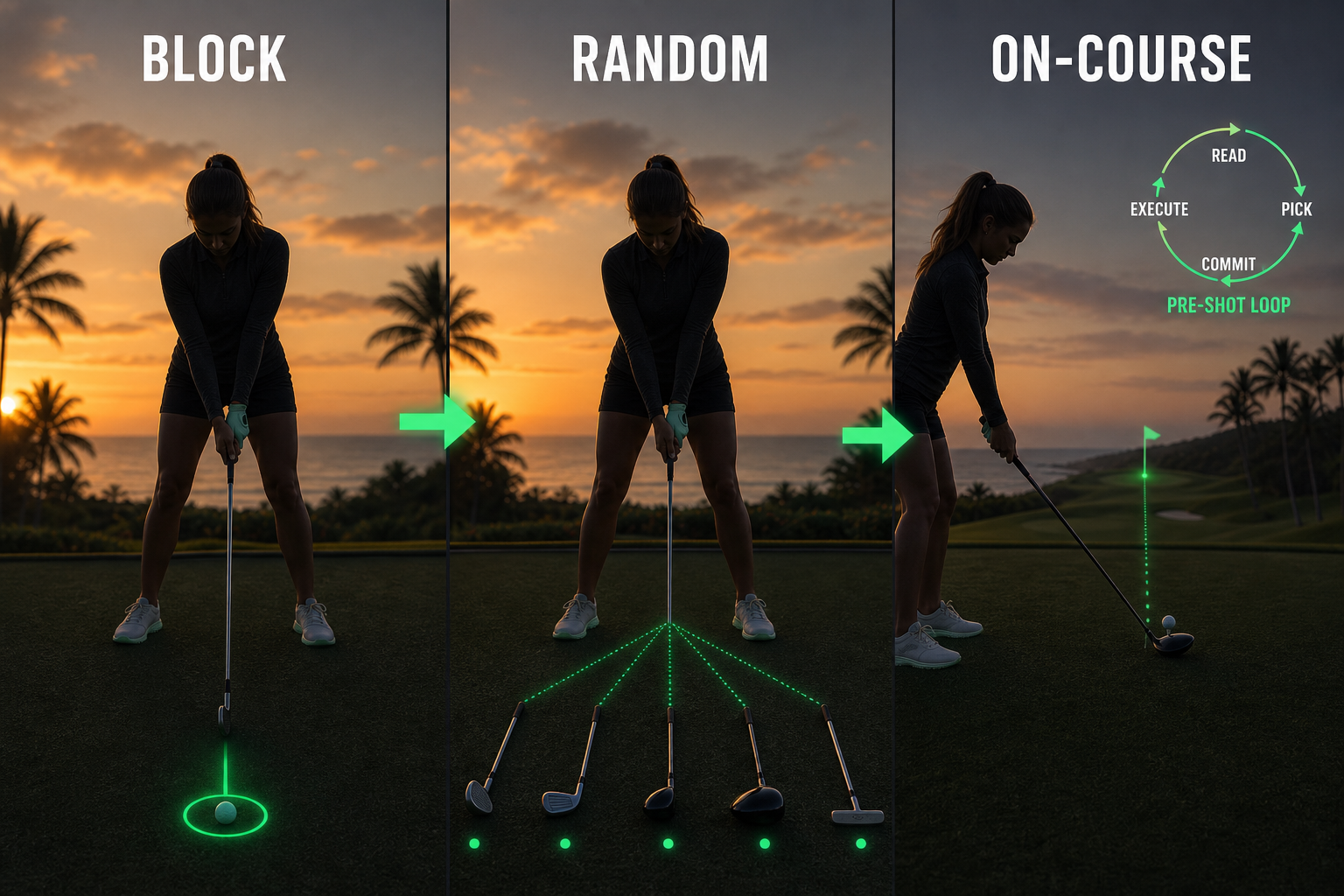
Step 1: Block Practice (Install)
Block mode is Learn It and Prove It of the daily blueprint:
- one delivery rule (shallowing, bounce skim, pendulum stillness, etc.)
- one constraint (exit gate, tee under leading edge, wall, tee gate)
- reduced speed (10% Speed Protocol)
Exit from block: 8 of 10 reps clear the constraint at 70% speed without conscious body-part focus.
Step 2: Random Practice (Stress-Test)
Random mode is Play It expanded—variation is the constraint:
- Change target every rep — different start line, distance, or landing spot
- Change club every 3–5 reps — when training full swing or short game
- Change lie when available — tight, rough, uphill lie
- Run full Pre-Shot Loop — treat every rep like a tournament shot
- Session structure — pressure games, surfaces, and category random draws in Course Management & Transfer
If shallowing holds on rep 1 but fails on rep 7 with a new target, the pattern is not installed—it is block-dependent. Random practice exposes what block practice hides.

Step 3: On-Course Transfer (Prove)
On-course transfer does not mean playing 18 holes and hoping. It means deliberate scoring reps with the same external focus used on the range:
- Pick one pattern per round—or per nine—not three swing changes at once
- Run the Pre-Shot Loop on every shot that uses the pattern (full routine, not a abbreviated version)
- Score process, not outcome — constraint cleared or routine completed = success, even on a mishit
- Diagnose reversion — if the old fault returns under pressure, drop back to random mode on the range; do not add a new swing thought on course
Trying to install GRF, J-Curve, and bounce geometry in the same round guarantees reversion to the most myelinated fault. One pattern per transfer block.
Exit Criteria: When Is a Pattern Installed?
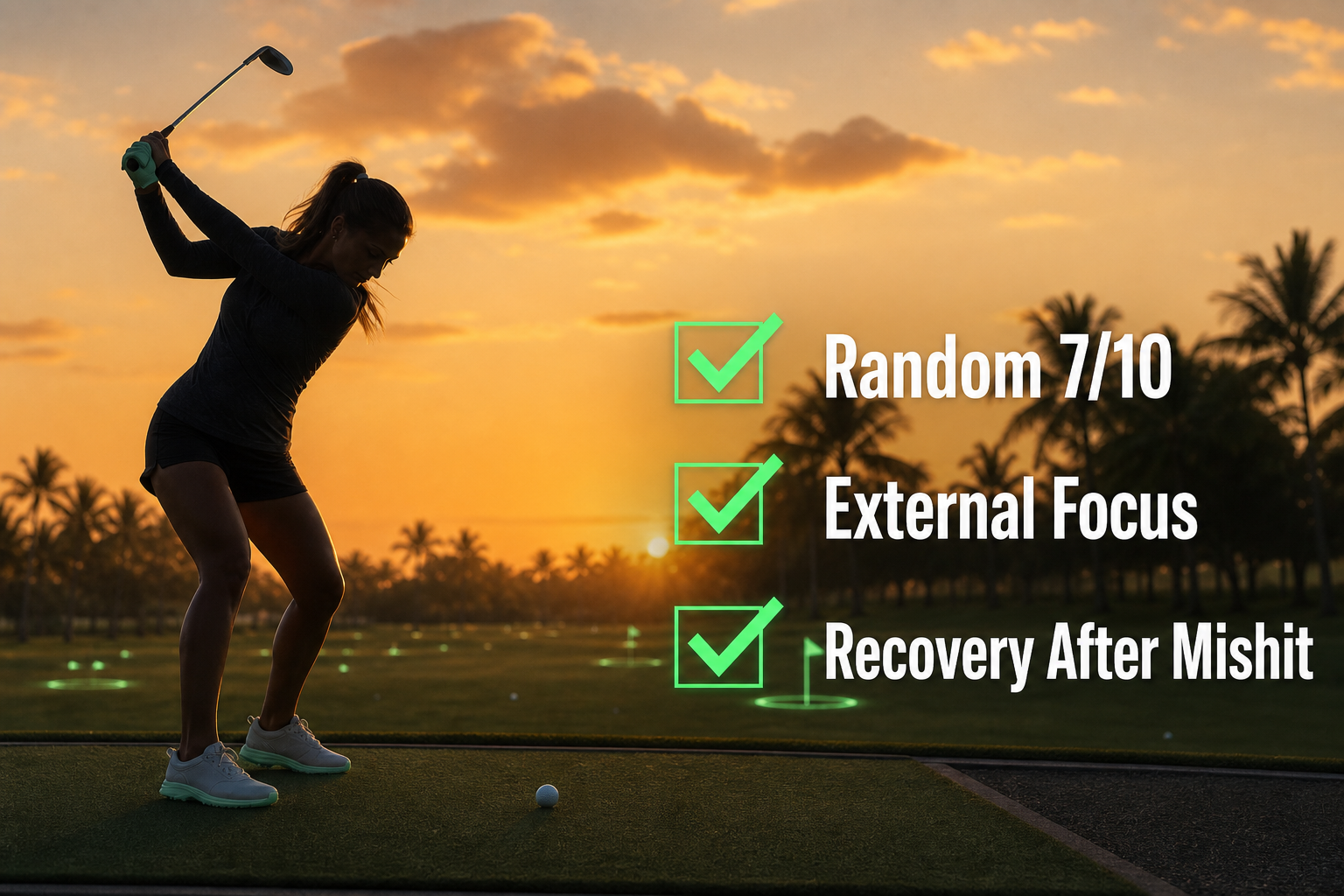
A pattern is installed when all three conditions hold across two consecutive sessions:
| Criterion | Standard |
|---|---|
| Random mode | 7 of 10 reps hold delivery rule across varied targets/clubs at full tempo |
| Constraint | No conscious body-part focus during execution—external target only |
| Recovery | After one mishit, next rep returns to pattern without a swing-thought reset |
Once installed, rotate to the next pillar in the blueprint training sequence—or to a Faults & Fixes correction if that fault was the trigger. Symptom routing: overview table; Short Game / Putting: Faults by Swing Category.
If criteria fail on session two, return to block mode at 30% for 20 reps—not full speed troubleshooting.
Bridging with the Pre-Shot Loop
The Pre-Shot Loop is the transfer bridge. Range reps that skip routine build one context; course shots that use routine build another. Play It and on-course transfer must include:
- calibration swing at ~20% speed (or category programming step — see Pre-Shot by Swing Category)
- intermediate target / start-line lock / landing spot / Level call
- programmed speed or Level before takeaway
After a mishit, Recovery & Reset Protocol defines on-course behavior — one external rule, full loop, no stacked fixes.
Without the loop, range patterns and course patterns are different skills.
If Play It random reps feel easy but the first tee feels foreign, the routine was skipped on the range. Add the full Pre-Shot Loop to Play It before declaring random-mode success.
Grooving This Pattern
Grooving this pattern
Transfer Protocol
Delivery rule
the installed pattern survives context change—not range-only block reps.
Work through the three steps below in order—don't skip ahead.
1. Learn It
~10% of your max · block mode · single target — 10% Speed Protocol
Map the delivery rule without ball-flight obsession
the installed pattern survives context change—not range-only block reps. — map geometry at checkpoints; no rush. After each rep: Constraint or dry-run geometry stable before adding speed
2. Prove It
~30–70% of your max · ball on
add a ball at processable speed—the same constraint must clear. Ball flight does not matter.
8 of 10 constraint clears before advancing to random mode
3. Play It
Up to 100% of your max · random mode
game speed, full Pre-Shot Loop on every rep when ready.
7 of 10 delivery-rule holds with full routine timing
One delivery cue under random context—score process, not outcome
If criteria fail on session two, return to block mode at 30% for 20 reps—not full-speed troubleshooting
Two strong random sessions beat ten block sessions at the same pattern. When exit criteria are met, move on—the nervous system needs new variation to keep installing, not repetition of what is already stable.
The Cheatcode for your Game