Practicing by Swing Category
The Learning Blueprint operating system is universal: constraint-led practice, 10% speed, 50 reps, progressive chaining. What changes is the delivery rule and the constraint—not the process.
Practicing by Swing Category maps the same three-phase daily structure to The Full Swing, The Short Game, and Putting so every Grooving block on Method pages runs against the same playbook.
Universal Rules (All Categories)
Every session, regardless of category:
- State the delivery rule before rep 1 — one sentence, external focus
- Run 10% Speed Protocol for any new pattern
- Cap at 50 high-fidelity reps — stop when signal quality drops
- Play It = random + Pre-Shot Loop — see Transfer Protocol
Every pillar below uses the same 50-Rep Daily Blueprint (Learn It 10 → Prove It 20 → Play It 20). Open Grooving on the pillar page for phase speeds, Focus lines, and Supports.
Pillar quick reference
Train one pillar per session in blueprint order. Primary drill owns Learn It Do and usually Play It Rule reset; If you get stuck on the Grooving card lists optional add-ons when you need them.
Full Swing
| Order | Pillar | Primary drill | Grooving |
|---|---|---|---|
| 1 | Ground Reaction Forces | Step-Up Drill | Session plan |
| 2 | Elbow Plane | Pump Drill | Session plan |
| 3 | J-Curve Hand Path | Slow J-Curve mirror rehearsals (no ball) | Session plan |
| 4 | The Coil | Slow coil rehearsals (no ball) | Session plan |
| 5 | Impact & Compression | Slow impact rehearsals (no ball) | Session plan |
| 6 | Wrist Mechanics | Slow set-and-hold wrist rehearsals (no ball) | Session plan |
Blueprint map: Full Swing Blueprint · Symptom routing: Faults & Fixes
Short Game
| Order | Pillar | Primary drill | Grooving |
|---|---|---|---|
| 1 | Geometry of Bounce | Bounce + U-path dry rehearsals (no ball) | Session plan |
| 2 | Hinge-and-Hold Myth | Trail-Hand Chip Protocol | Session plan |
| 3 | Trajectory Control | Lob/checker setup rehearsals (no ball) | Session plan |
| 4 | Carry Calibration | Level 1–3 dry runs (constant tempo) | Session plan |
| 5 | Shot Selection & Landing Zones | Four-read verbalization (no club until spot locked) | Session plan |
Shot applications (after core pillars are stable):
| Shot | Primary drill | Grooving |
|---|---|---|
| Tight-Lie Chip | Tee-under-leading-edge rehearsals (no ball) | Session plan |
| Bump-and-Run | 8-iron/PW address rehearsals + landing spot | Session plan |
| Bunker Shots | Open-face splash in dry sand (no ball) | Session plan |
Lie/symptom router: Short Game Shot Library · Blueprint: Short Game Blueprint
Putting
| Order | Pillar | Primary drill | Grooving |
|---|---|---|---|
| 1 | Planar Pendulum | Wall constraint strokes (no ball) | Session plan |
| 2 | Face Angle vs. Path | Start-Line Gate Protocol | Session plan |
| 3 | Speed Programming | Metronome Levels 1–3 (constant tempo) | Session plan |
| 4 | Green Reading Algorithms | Straddle-line sensor drills (walk line, no putts) | Session plan |
Distance applications (after Levels and read loop are stable):
| Application | Primary drill | Grooving |
|---|---|---|
| Lag Putting & Leave Zones | 30–40 ft putts to leave zone (Levels 2–3) | Session plan |
| Short Putts & Make Zone | 12-inch tee gate passes (2–4 ft) | Session plan |
Blueprint: Putting Blueprint · Head stillness aid: Forehead Post pairs with pendulum and gate work
The Full Swing
Delivery rules come from the Full Swing Blueprint training sequence: GRF → Elbow Plane → J-Curve → Coil / Impact / Wrist structure as bookends.
| Phase | Objective | Typical constraints & drills |
|---|---|---|
| 1 — Learn it | ~10% of your max (dry runs); map one frame or sequence | Progressive chaining freeze frames; Step-Up Drill dry |
| 2 — Prove it | ~30–70% of your max, constraint cleared | Sternum tracker, plane station, exit gate, wrist hinge trainer; Pump Drill, Split-Grip |
| 3 — Play it | Random clubs/targets; full routine | Change iron/hybrid/driver every rep; GRF post + external target |
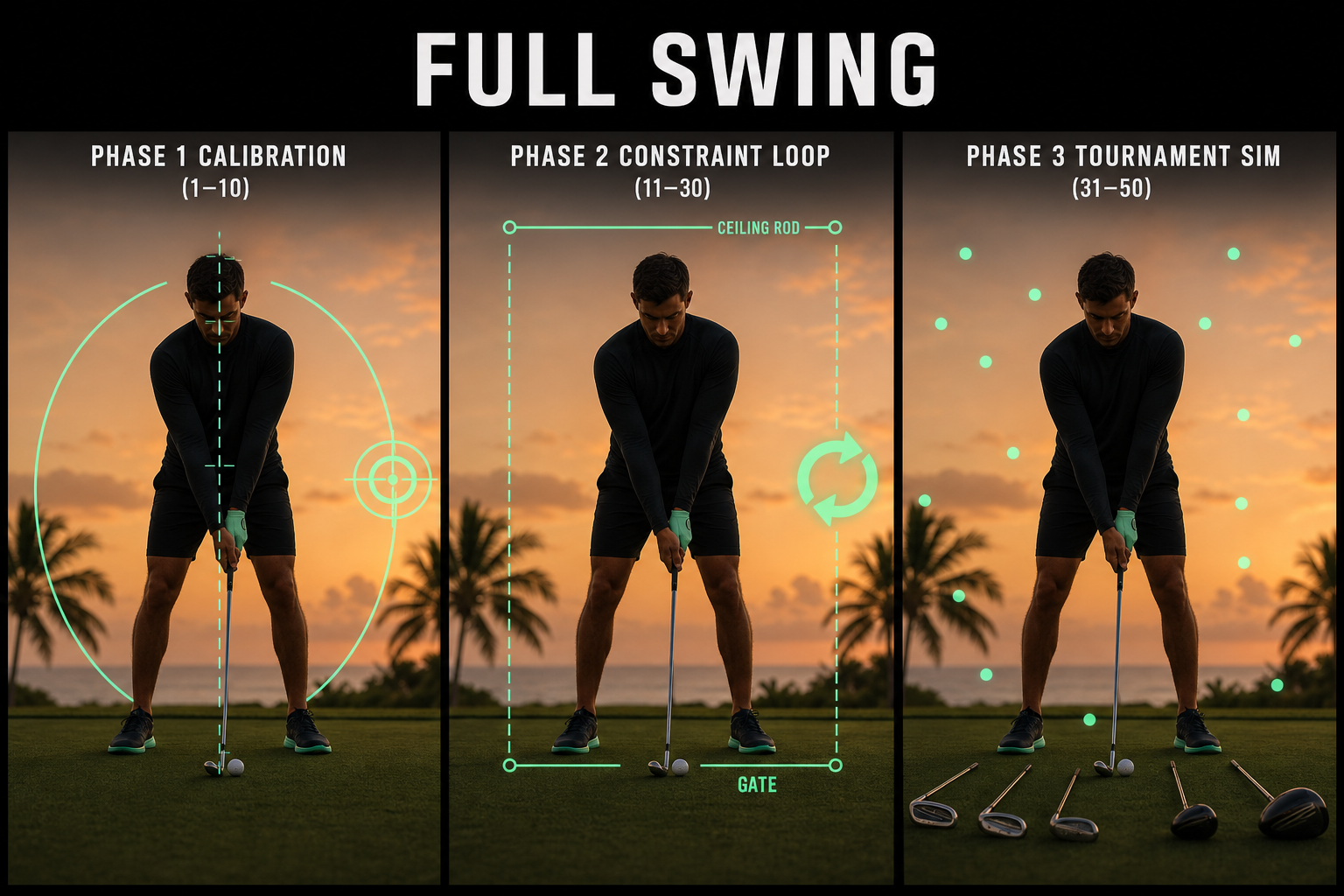
Running Ground Reaction Forces calibration at full speed with a driver and ball obsession reverts to arm swing. GRF installs at 10% with Step-Up Drill—no ball until stomp and vertical thrust are stable.
The Short Game
Delivery rules come from the Short Game Blueprint: bounce skim → passive release → trajectory window → carry Level → landing spot.
| Phase | Objective | Typical constraints & drills |
|---|---|---|
| 1 — Learn it | ~10% of your max; setup rehearsals; U-path dry runs | Open face + neutral shaft; no turf contact |
| 2 — Prove it | ~30–70% of your max; skim quality; hollow thump | Tee under leading edge; Trail-Hand Chip Protocol |
| 3 — Play it | Random lie + lob/checker calls | Carry matrix Levels; call landing spot every rep |
Play It success metric is constraint or landing spot—not hole-out rate on calibration days. Tactical routing: Short Game Shot Library.
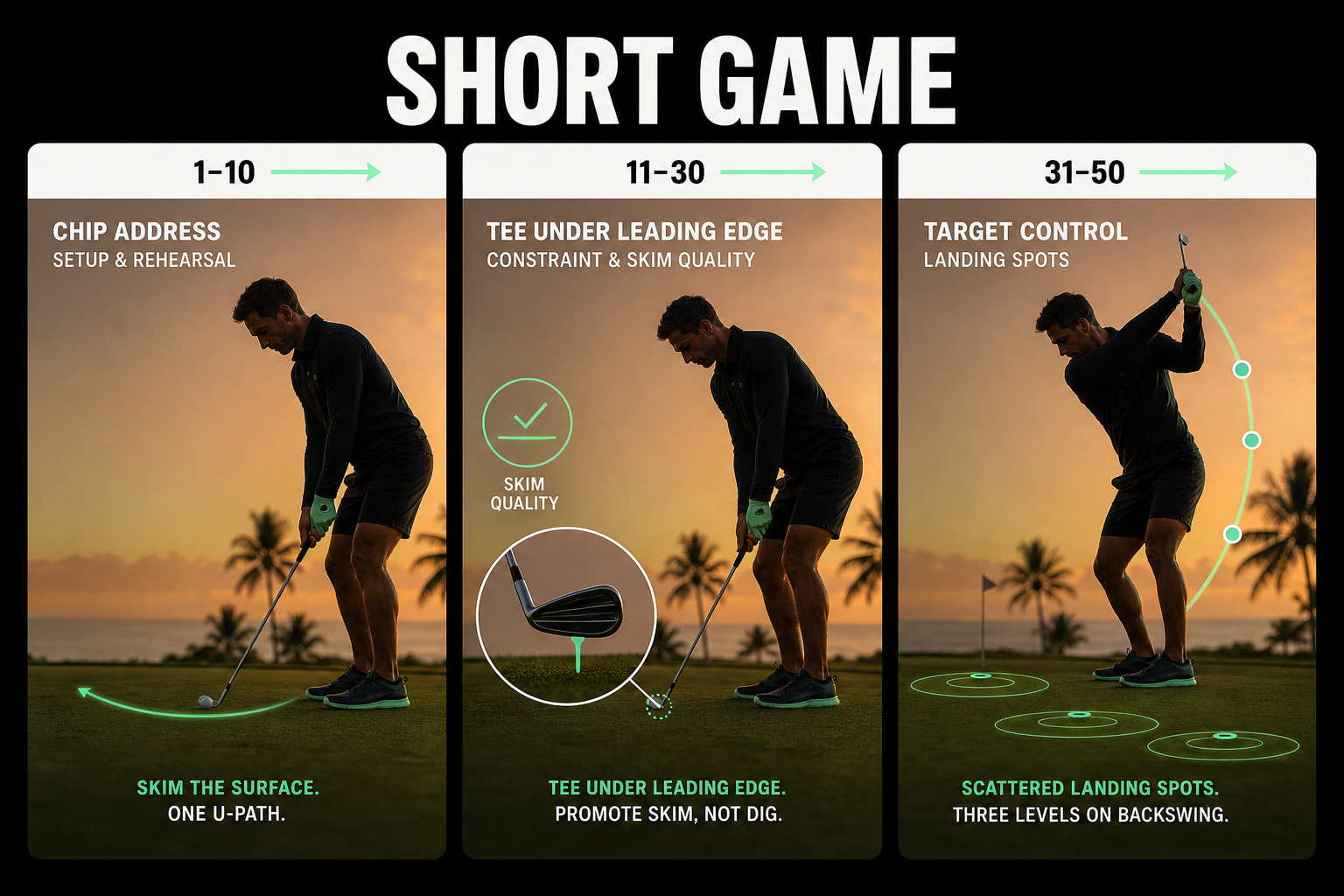
Short-game Play It that chases hole-outs usually reintroduces hinge-and-hold. Score skim quality and carry Level accuracy first.
Putting
Delivery rules come from the Putting Blueprint: pendulum → face/start line → Speed Level → read loop → lag leave zone / make zone.
| Phase | Objective | Typical constraints & drills |
|---|---|---|
| 1 — Learn it | Constant tempo; wall strokes; gate dry runs | Head on wall; 6-inch intermediate target |
| 2 — Prove it | Same tempo; gate passes; Level mapping | Start-Line Gate Protocol; metronome Levels 1–3 |
| 3 — Play it | Random distance + break calls | Full read loop + programmed Level; lag leave ring or make-zone gate |
Play It does not use GRF language—success is head stillness, gate clearance, or leave-zone finish.
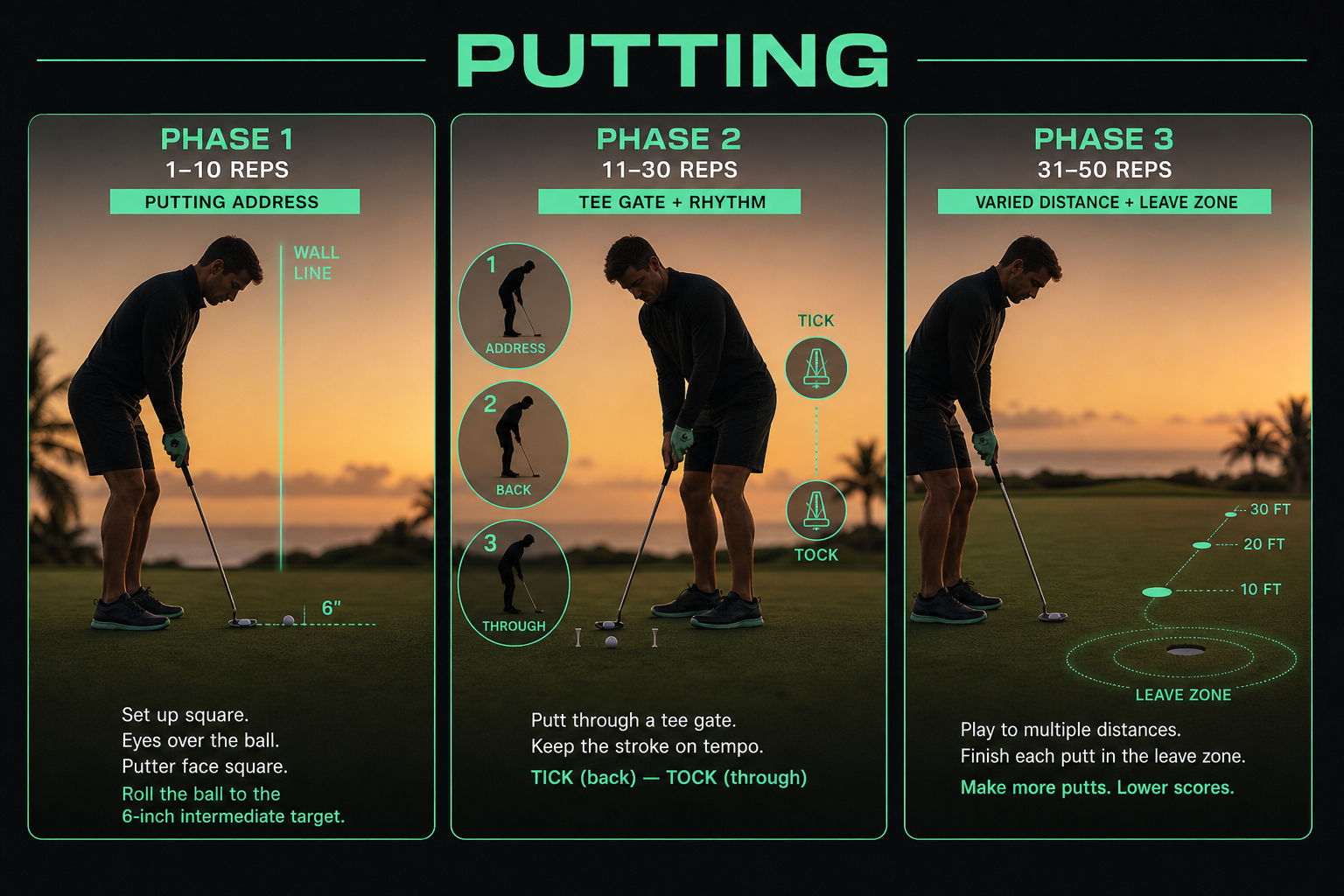
Programming Speed Levels then punching or decelerating at impact breaks the 2D pendulum. Tempo constant; length only.
Category Quick-Reference
| Full Swing | Short Game | Putting | |
|---|---|---|---|
| Primary constraint type | Spatial (gates, rods) | Turf interaction (tee, skim) | Planar (wall, gate) |
| Play It variation | Club + target | Lie + trajectory + landing spot | Distance + break |
| Wrong metric | Distance only | Hole-outs only | Make rate during calibration |
| Right metric | Constraint cleared | Thump + carry Level | Gate / leave zone |
| Blueprint entry | Full Swing | Short Game | Putting |
Grooving This Pattern
When a Method page says Grooving This Pattern, it is this category map applied to one pillar. Cross-reference:
- Which swing category am I in?
- Which delivery rule from that blueprint?
- Which constraint from the table above?
- When do I graduate? — Transfer Protocol exit criteria
- How do I structure Play It sessions? — Course Management & Transfer random + pressure catalog
Mixing full-swing GRF work and putting gate work in the same 50-rep session splits attention and doubles CNS load. Run one category per session; rotate across the week.
On-course faults by category: Faults by Swing Category · symptom routing table.
The Cheatcode for your Game