Constraint-Led Practice: Environmental Optimization
Final Boss Golf does not recalibrate the Final Boss Method with traditional swing thoughts. Internal cues—"keep the lead arm straight," "tuck the elbow," "hold the lag"—introduce processing lag in a motion that completes in under a second. The result is paralysis by analysis and degraded motor learning.
Constraint-Led Practice replaces internal micromanagement with external geometry. The environment teaches the body what to do.
The External Focus Advantage
Constraint-led practice shifts attention from body parts to delivery outcomes. Physical barriers make flawed geometry expensive:
- a steep, over-the-top path collides with a ceiling rod
- a linear release collides with an exit gate
- a scoop pattern collides with a towel behind the ball
- a digging wedge strike collides with a tee under the leading edge
- a steering putt fails a tee gate on the start line
When a flawed movement produces immediate physical feedback, the nervous system self-organizes around the one viable solution.
The moment focus shifts to wrist angle or elbow position mid-downswing, spatial awareness collapses and rotational speed drops. Final Boss Golf prioritizes where the club must travel, not how to pose the body.
Full Swing Constraints
Four core constraints map to The Full Swing. Repeatable station pages live under Training Aids.
1) Isolating the J-Curve (Exit Constraint)
To recalibrate a linear "straight down the line" release:
- place a headcover, foam barrier, or tee box 12 inches past the ball on the target line — see Exit Gate Station
- if the hands drive linearly forward, the clubhead hits the object
- to avoid collision, the body clears the lead hip and pulls the handle In and Up
- centrifugal force squares the face through parametric acceleration (see J-Curve)

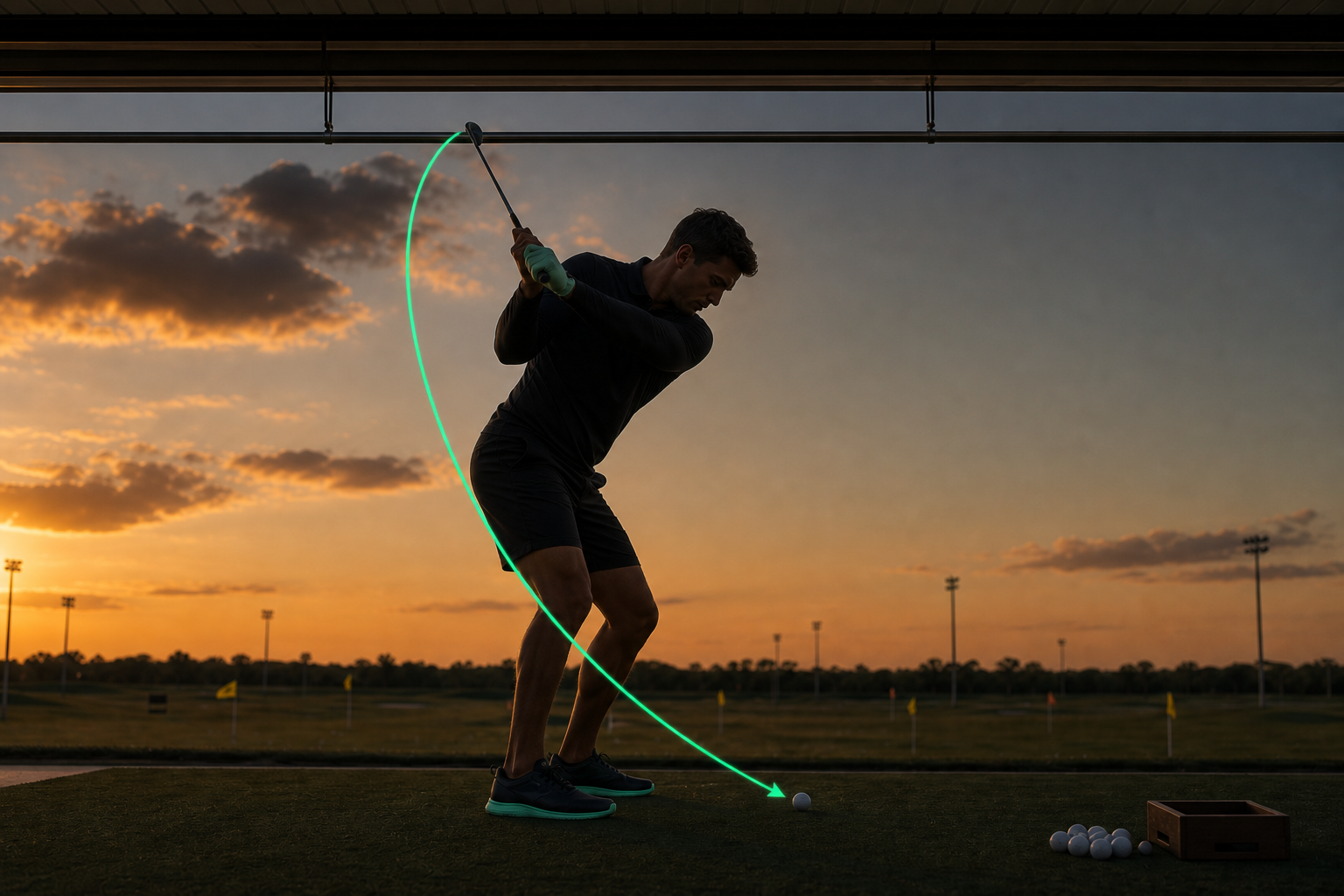
2) Navigating the Elbow Plane (Ceiling Constraint)
To block steep, over-the-top delivery:
- set an alignment rod angled from behind the ball, matching shaft angle at address (the "ceiling") — see Plane Station Connector
- backswing tracks above or parallel to the rod
- transition must shallow under the ceiling by tucking the trail elbow
- the shaft drops into the Elbow Plane slot
3) Sternum Connection (Fake-Turn Constraint)
To block arm lift disguised as rotation:
- install a chest-axis reference — alignment rod under armpits or Sternum Axis Tracker
- hands must stay in front of the sternum through takeaway and top
- arm sweep across the chest plane = fake turn → see The Coil
4) Lead Wrist Structure (Face Constraint)
To block cupped lead wrist and open-face delivery:
- tactile forearm contact at — Wrist Hinge Trainer
- separation = extension = open face; restore flat/flexed structure before delivery
- pair with Split-Grip Station to remove flip lever at release — see Wrist Mechanics
Short Game Constraints
Short-game constraints target turf interaction, not path shape:
3) Exposing Bounce (Leading-Edge Tee)
To block leading-edge digs on tight lies:
- place a tee or coin under the leading edge at address
- the wedge must skim over the object through impact
- collision means the shaft leaned forward or the path steepened—see Geometry of Bounce
4) Passive Release (Trail-Hand-Only)
To kill hinge-and-hold tension:
- chip with trail hand only for calibration reps — Trail-Hand Chip Protocol
- rigid lead-hand holding becomes physically expensive
- objective: neutral shaft and clubhead passing the hands at impact
Putting Constraints
Putting constraints target planar stability and start line:
5) Pendulum Stillness (Wall Constraint)
To block full-swing body bleed in a planar stroke:
- head gently touches a wall during practice strokes — Forehead Post (Constraint 1 only; not full Wall Walk)
- shoulders rock; head does not shift
- see The Planar Pendulum
6) Start-Line Gate (Tee Gate)
To calibrate face angle at impact:
- Start-Line Gate Protocol — two tees 12 inches ahead on the start line
- ball must roll through the gate—lateral miss = face delivery fault, not read error
Category Reference
Full constraint maps and Prove It pairings live in Practicing by Swing Category. Repeatable full-swing hardware: exit gate, plane station, sternum tracker, wrist hinge trainer. Short Game and Putting constraints use range improvisation—see Drills.
On course: constraints become external outcomes — intermediate targets, landing spots, Level calls — via the Pre-Shot Loop and Pre-Shot by Swing Category. See Transfer Protocol for the graduation path.
Run every constraint at reduced speed first (10% Speed Protocol), then scale velocity only after the obstacle is cleared consistently. Speed without constraint clearance reinforces the old pattern faster.
Grooving This Pattern
Grooving this pattern
Constraint-Led Practice
Delivery rule
clear the obstacle—exit gate, rod, tee skim, wall, or putting gate—not body-part positioning.
Work through the three steps below in order—don't skip ahead.
1. Learn It
~10% of your max · no ball
Set up one constraint; dry-run the delivery path without contact
clear the obstacle—exit gate, rod, tee skim, wall, or putting gate—not body-part positioning. — map geometry at checkpoints; no rush. After each rep: Attention on clearing the obstacle or hearing the correct contact (e.g., hollow thump on bounce)
2. Prove It
~30–70% of your max · ball on
add a ball—the same constraint must clear on contact. Ball flight does not matter.
Constraint clears 8 of 10 reps—not make-rate or carry obsession
3. Play It
Up to 100% of your max · game speed
game speed, new target/club/lie (or distance and break on putting), and the full Pre-Shot Loop when ready.
Constraint or landing spot under random variation—not a body-part checklist
Stacking exit gate, ceiling rod, and tee skim in one session splits attention. Pick the single constraint that matches today's delivery rule.
The Cheatcode for your Game