The 50-Rep Daily Blueprint: Movement Patterns
Final Boss Golf rejects the "200 balls in an hour" model. High-volume, low-attention repetition builds fatigue, not skill. Motor learning needs signal quality, recovery between reps, and constraints that block legacy faults.
The daily cap is 50 high-fidelity reps. After 50, deep learning yield drops—stop and save the session.
Every Core Mechanics Grooving This Pattern block on Method pages is this blueprint applied to one pillar. Category-specific constraints and Play It metrics live in Practicing by Swing Category.
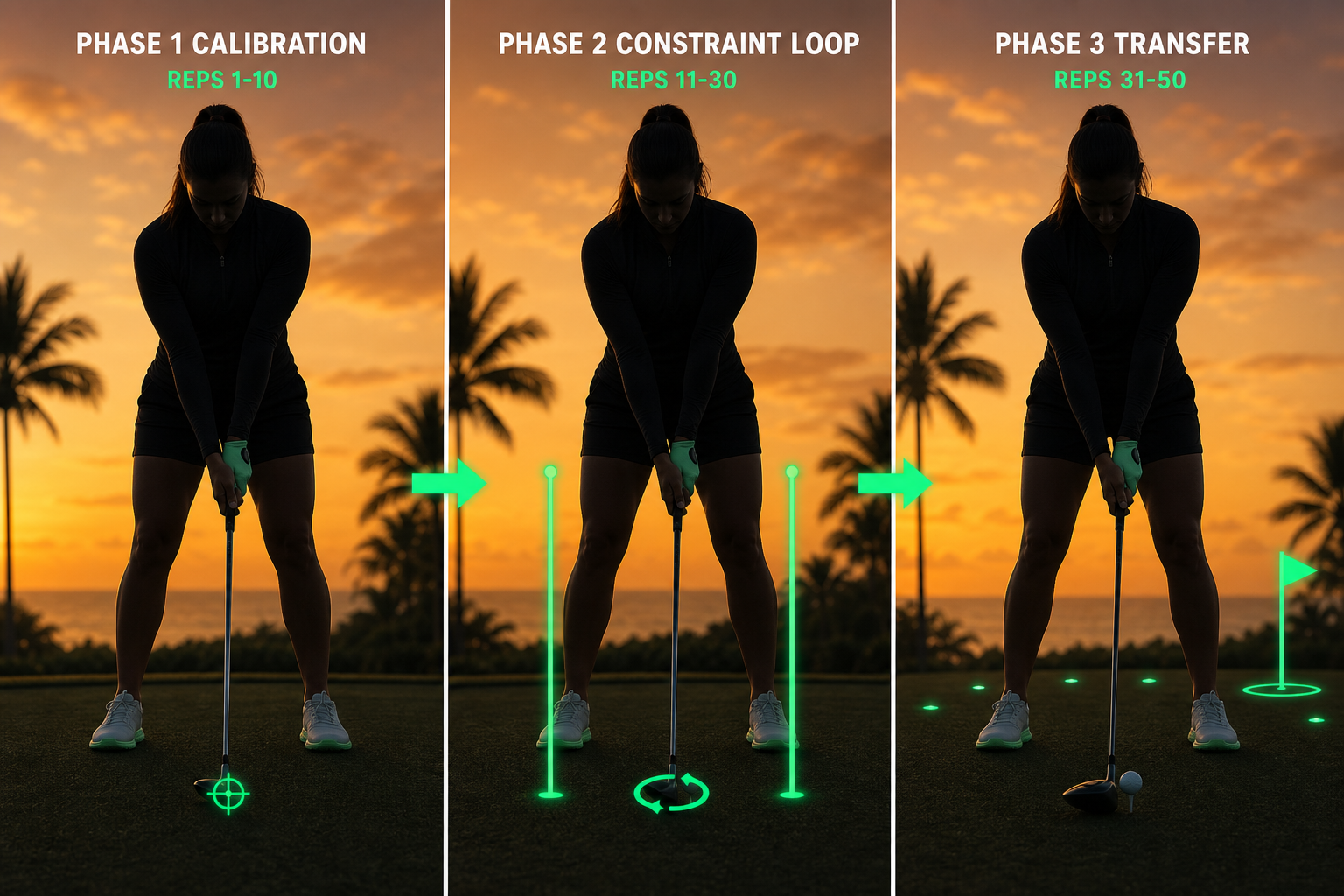
Each session is 10 + 20 + 20 = 50 reps (Learn It → Prove It → Play It). Percentages are your max—not tour speed. Learn It: ~10% of your max · no ball. Prove It: ~30–70% of your max · ball on (climb only after 8/10 at the current tier—see 10% Speed Protocol). Play It: Up to 100% of your max · game speed. Putting uses constant tempo and stroke length, not clubhead % (Speed Programming).
Neurological Fatigue
The central nervous system coordinates unfamiliar geometry with expensive processing. Rapid-fire reps cause:
- degraded signals (spatial awareness drops)
- reversion to myelinated faults
- reinforcement of the wrong pattern
Dragging the next ball into place without reset trains low-fidelity loops. Each rep needs a full pre-shot calibration: aim, setup, intent, execute, process feedback.
The 50-Rep Structure
Phase 1: Learn It (10 reps)
- Practice Speed: ~10% of your max · no ball (putting: dry strokes only) — 10% Speed Protocol
- Do: 10% Speed Protocol static hold + dry runs—map one delivery rule (GRF stomp, bounce skim, pendulum stillness, etc.)
- Check: Geometry visible on video or felt at checkpoints—no rush
- Focus (internal): One delivery rule at ~10%—geometry on video or at freeze checkpoints; no rush
Phase 2: Prove It (20 reps)
- Practice Speed: ~30–70% of your max · ball on
- Same as Learn It, but: add a ball and one Constraint-Led Practice obstacle—exit gate, ceiling rod, tee under leading edge, putting gate, or wall. Ball flight does not matter.
- Prove: Clear the constraint 8 of 10 reps—not ball flight or make-rate obsession
- Focus (constraint): The obstacle on each rep—clear it 8 of 10; ball flight does not matter
Phase 3: Play It (20 reps)
- Practice Speed: Up to 100% of your max · game speed
- Same as Prove It, but: game speed, random target/club/lie (or distance and break on putting), and the full Pre-Shot Loop when ready—on the range or on the course.
- Focus (external): Delivery rule holds under variation (category-specific success metric from Practicing by Swing Category)—not a body-part checklist. See External vs. Internal Focus
- Rule: After a breakdown, reset with one Learn It rep—do not rush into the next ball
| Category | Play It success metric (not GRF-specific) |
|---|---|
| Full Swing | Constraint cleared; GRF post + external target |
| Short Game | Skim quality / carry Level hit |
| Putting | Gate clearance, leave zone, or make-zone gate |
Between Prove It and Play It reps, wait at least 60 seconds. Use the interval to process tactile and visual feedback. Cooldowns reduce CNS burnout and accelerate pattern installation.
When to Stop vs. Graduate
- Stop at 50 reps — signal quality drops; save the session
- Graduate the pattern — when Transfer Protocol exit criteria are met across two sessions (7/10 random reps, external focus, recovery after mishit)
- One category per session — do not mix full-swing GRF and putting gate work in the same 50 reps
The Cheatcode for your Game