The 10% Speed Protocol: Movement Patterns
Recalibrating Final Boss Method mechanics is not a thought change—it is a motor-pattern change. Final Boss Golf treats that change as a myelination problem: old patterns are fast because they are insulated; new patterns are slow until they earn the same insulation.
What “10%” means: Roughly 10% of your maximum clubhead speed for that club and motion—not 10% of a tour player's speed. The goal is time to verify geometry before myelinated faults take over. Method and drill pages label the same tiers as Practice Speed in the 50-Rep Daily Blueprint.
The Myelin Barrier
Repeated movement wraps neural circuits in myelin, reducing signal loss and increasing speed. A decade of early extension, steep delivery, or hinge-and-hold creates a path of least resistance.
At full speed, the brain cannot route through an uninsulated pathway in time. It defaults to the old pattern.
The ball triggers "hit it hard" programming. During initial recalibration, remove the ball so the nervous system can map geometry without defaulting to the old full-speed pattern.
The Recalibration Ladder
New geometry must be built slow, then scaled. This ladder applies to every swing category—see examples in Practicing by Swing Category.
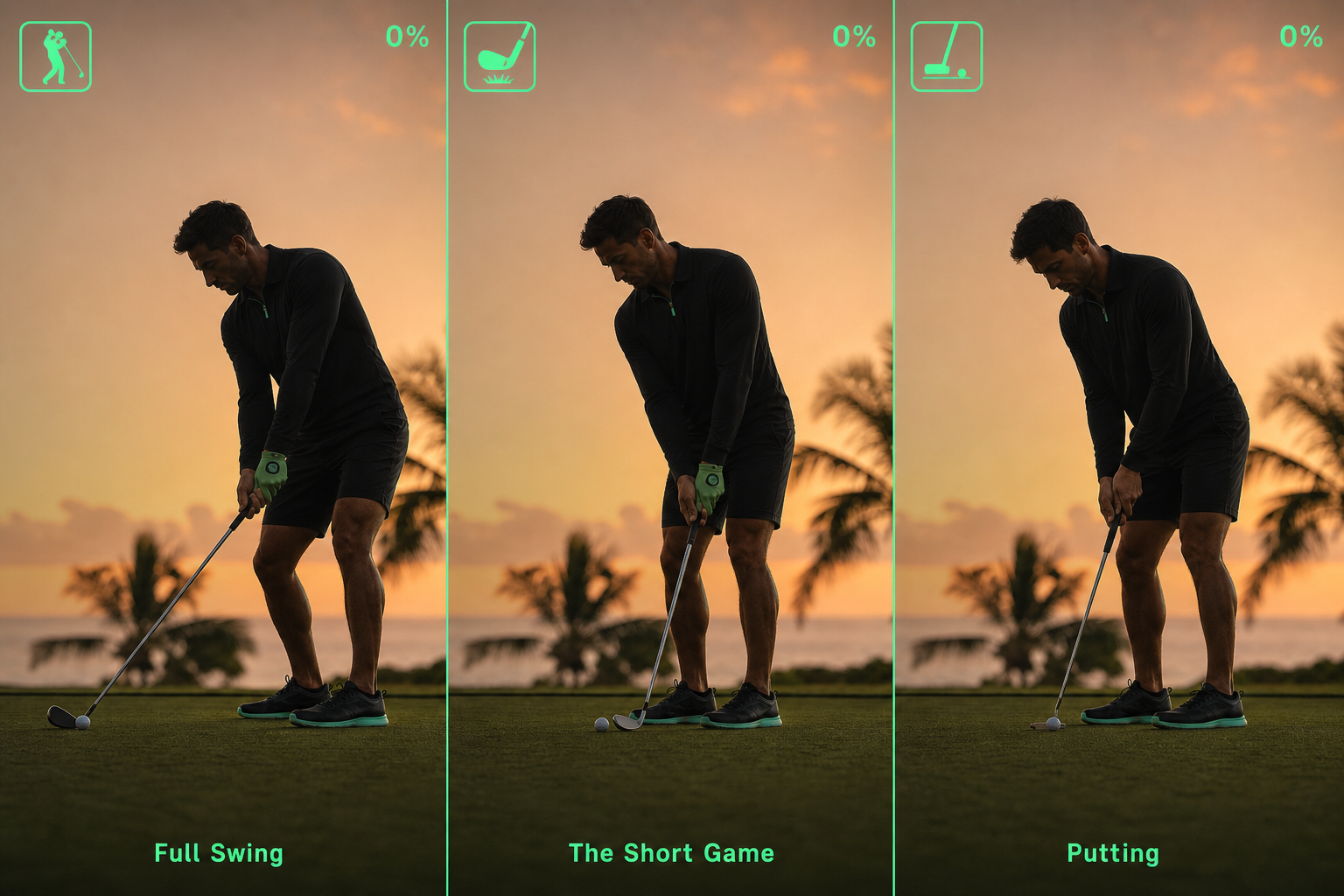
Step 1: Static Hold (0%)
- The Mechanic: Hold the target geometry for ~10 seconds without motion.
- Examples: Impact frame with forward shaft lean (Full Swing); open face + neutral shaft (Short Game); locked triangle at address (Putting).
- The Output: Proprioceptive map of the end position before adding motion.
Step 2: 10% Dry Runs (No Ball)
- The Mechanic: One rep = 10–15 seconds. Fluid motion at roughly 10% of full speed. No ball.
- The Output: Conscious attention stays online long enough to verify checkpoints (shallowing, U-path skim, pendulum arc).
Step 3: 30% Strike (Ball Reintroduced)
- The Mechanic: Teed ball or tight lie at ~30% speed. Structure through delivery—not distance or make rate.
- The Output: Contact confirms geometry; ball flight is diagnostic only.
Step 4: Gradual Scaling (50% → 70% → 100%)
- The Mechanic: Increase speed only when the pattern holds at the current tier.
- The Rule: If the fault returns at 70%, drop back to 30%—do not push through with swing thoughts.
At slow speed, a 1-inch position change feels enormous. Record 10% reps and verify geometry objectively—shallowing, handle path, bounce skim, or head stillness—before adding speed.

Category Speed Notes
| Category | What to verify at 10% | Ball reintroduction |
|---|---|---|
| Full Swing | GRF stomp, slot shallowing, J-Curve path | Teed mid-iron at 30% |
| Short Game | U-path, open face, passive release | Tight lie chip at 30% |
| Putting | Wall stillness, shoulder rock | Flat 6-foot putt at 30% tempo |
Putting uses tempo constant at all tiers—never punch or decel to add distance (Speed Programming).
Grooving This Pattern
Grooving this pattern
The 10% Speed Protocol
The 10% ladder is the **Learn It** block in the 50-Rep Daily Blueprint. Do not skip to Prove It until Step 3 (30% strike) holds the delivery rule.
Delivery rule
each tier of the 10% ladder holds the same geometry before contact and speed advance.
Work through the three steps below in order—don't skip ahead.
1. Learn It
~10% of your max · no ball — 10% Speed Protocol
Static hold + dry runs for one delivery rule
Geometry visible on video or felt at checkpoints—no rush
2. Prove It
~30% max, then ~50–70% only after 8/10 at the current tier · ball on
add a ball through Steps 3–4 of the ladder (30–70% of your max)—same delivery rule at each tier. Ball flight does not matter.
Constraint-Led Practice clears 8 of 10 reps at processable speed
3. Play It
Up to 100% of your max · game speed
game speed, new target/club/lie (or distance and break on putting), and the full Pre-Shot Loop when ready.
Transfer Protocol random mode—not a body-part checklist
Players who skip 10% to "save time" usually spend twice as long fighting full-speed reversion. Myelin installs at the speed the pattern is actually performed correctly.
The Cheatcode for your Game