The Step-Up Drill: Vertical Force Generation
Low terminal velocity often traces to upper-body dominance—arms and shoulders trying to supply speed while ignoring Ground Reaction Forces (GRF).
The Step-Up Protocol maps vertical force: step, load, stomp, extend—the same sequence detailed on the GRF page.
Trains
- Ground Reaction Forces — re-center, stomp, verticle post
- The J-Curve Hand Path — handle In-and-Up powered by lead-leg extension
- Impact & Compression — posted lead leg, forward low point
- Faults: arm-dominant swing, flexed-knee spin-out, early extension compensation
Prerequisite: Forehead Post & Tailbone Glide if hub sways during the step.
Mechanical Fault: Rotational Spin-Out
Range wisdom shouts "clear the hips" and often means horizontal spin only:
- hips rotate without lead-foot pressure
- lead knee stays flexed, torso dives
- verticle post never fires
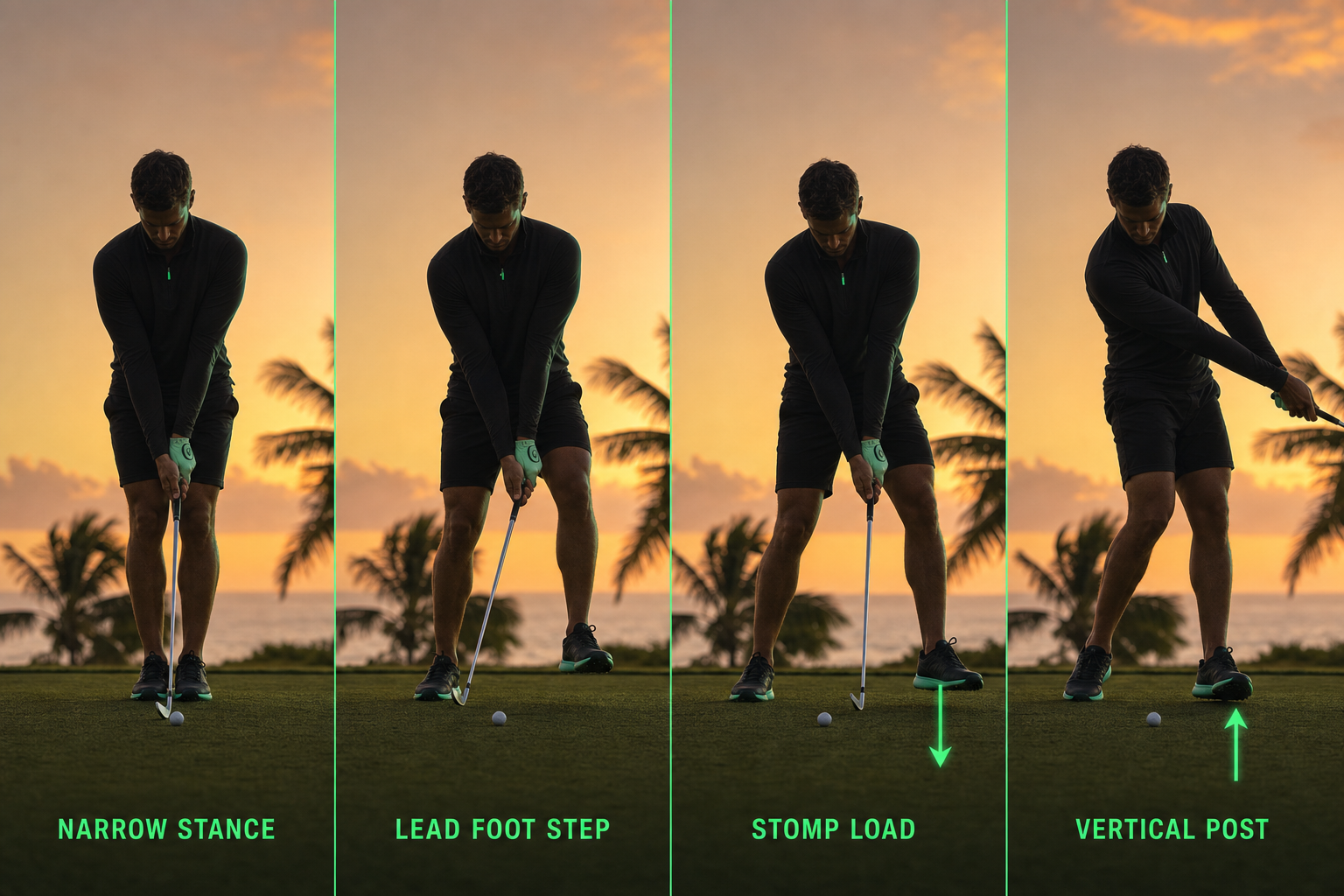
Protocol (Dry Runs First)
Phase 1: Narrow Stance
Mid-iron. Feet close together at address. Club hovers behind an imaginary ball line.
Phase 2: Re-Center (Early Step)
Start the backswing. Before hands reach the apex, lift the lead foot and step forward to normal stance width. Lower body moves forward while upper body still loads back—creates stretch and torque.
Phase 3: Stomp (Load)
As the lead foot lands, drive pressure down into the turf. This is the anchor for transition.
Phase 4: Verticle Post
Repel the ground: lead leg extends, lead hip elevates backward/upward. That vertical vector powers the J-Curve handle path.
The step establishes a post to push off—not permission to slide the upper body toward the target. Spine hub stays stable behind the ball.
Progression
- Forehead Post hub stable
- Step-Up Drill dry → 30% ball
- Wall Walk if early extension appears under load
Running the Drill
The Step-Up Drill is a tool, not a full session plan. For the integrated 50-rep session, follow the Ground Reaction Forces Grooving This Pattern plan and The 50-Rep Daily Blueprint. Use the progression below to dose the drill itself within those phases:
- Practice Speed: ~10% of your max · no ball — ~20 Step-Up cycles—step early, stomp, verticle post. Check: belt buckle elevates; no upper-body sway. — 10% Speed Protocol
- Focus (internal): Step early, stomp, verticle post—belt buckle elevates; no upper-body sway
- Practice Speed: ~30–70% of your max · ball on — Stomp before the arms; lead leg posts through impact. Ball flight is secondary to stomp-and-thrust timing.
- Focus (constraint): Stomp before the arms; lead leg posts through impact
- Practice Speed: Up to 100% of your max · game speed, varied clubs: Normal stance with the same step-up sensation—early re-center without a literal step on course.
- Focus (external): Early re-center sensation in normal stance—not a literal step on course
After ~20 clean dry runs, tee a ball at ~30% of your max. Priority is timing: step early, load heavy, extend through impact—not distance.
The Cheatcode for your Game