Forehead Post & Tailbone Glide: Axial Calibration
Before GRF or Elbow Plane work pays off, the central hub must stay stable. Dip, sway, or early extension shifts the swing center and forces micro-compensations at impact.
A wall provides immediate feedback for Forehead Post and Tailbone Glide constraints.
Trains
- Fundamentals — stable hub / low-point control
- The Coil — rotation without sway
- The Planar Pendulum — Forehead Post only for putting (head still; no tailbone sequence)
- The Geometry of Bounce — hub stable for skim contact
- Faults: early extension, fat/thin from shifting low point
Start here in most full-swing drill chains before Step-Up or Pump.
Axial Faults
- Sway (X-axis): hub slides laterally—low point becomes unpredictable
- Dip/elevate (Z-axis): spine height changes—radius collapses or expands
- Early extension (Y-axis): pelvis thrusts toward the ball—blocks J-Curve, invites flip

Constraint 1: Forehead Post
- Stand in golf posture without a club, arms crossed on chest.
- Hinge until forehead rests lightly on a wall (towel optional).
- Rotate the backswing slowly. Maintain steady forehead pressure through the top.
Putting use: This constraint alone—shoulders rock, head still. Pair with Start-Line Gate Protocol. Do not add tailbone glide for putting.
Sway grinds the head sideways. Standing up lifts the forehead off. Dipping drives excess pressure into the wall. Any change in contact = hub fault.
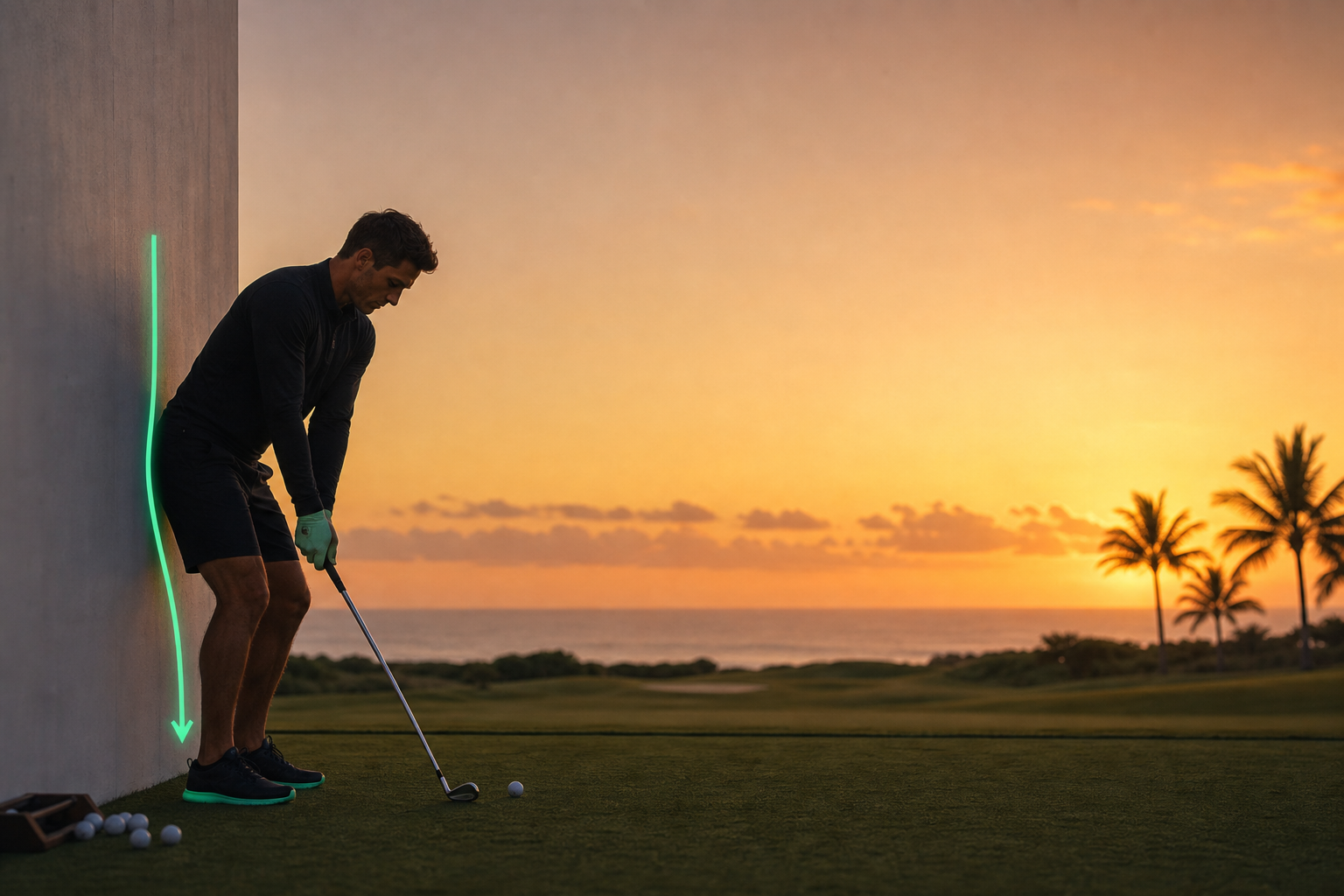
Constraint 2: Tailbone Glide (Full Swing)
- Stand with back to the wall, golf posture, tailbone touching.
- Rotate backswing: trail glute presses into the wall; lead glute clears slightly.
- Transition: both glutes can contact simultaneously (slight squat sensation) while tailbone glides along the wall—no thrust toward the ball.
The glide preserves pelvic depth (Y-axis) while mass re-centers. Full sequence → Wall Walk.
Progression
- Forehead Post & Tailbone Glide (this drill)
- Step-Up Drill or Wall Walk depending on fault
- Category-specific work (Pump, Start-Line Gate, Trail-Hand Chip)
Running the Drill
Forehead Post & Tailbone Glide is a foundational tool, not a full session plan. For the integrated 50-rep session, follow the Grooving This Pattern plan of the mechanic you are installing—most often Ground Reaction Forces or The Coil—and The 50-Rep Daily Blueprint. Use the progression below to dose the drill itself within those phases:
- Practice Speed: ~10% of your max · no ball — 10 Forehead Post rotations; 10 Tailbone Glide rotations (full-swing days). Check: constant wall contact per the constraint rules. — 10% Speed Protocol
- Focus (internal): constant wall contact per the constraint rules
- Practice Speed: ~30–70% of your max · ball on — Maintain the hub while brushing turf or hitting slow chips/putts. Putting: forehead post + Start-Line Gate.
- Focus (constraint): Maintain the hub while brushing turf or hitting slow chips/putts
- Practice Speed: Up to 100% of your max · game speed: Hub stability automatic—external focus on the target, not head position.
- Focus (external): Hub stability automatic—external focus on the target, not head position—not a body-part checklist
Run both constraints at 10% speed until hub stability is automatic. Unstable hubs make every downstream mechanic a compensation.
The Cheatcode for your Game