Tight-Lie Chip: Skim the Skid Plate
On a tight lie—fairway cut, hardpan, or bare ground—there is no cushion between the ball and the leading edge. Full-swing compression logic (forward shaft lean, steep descent) turns the wedge into a shovel. Final Boss Golf treats the tight-lie chip as a bounce-first strike: expose the skid plate, deliver a shallow U-path, and let passive release pass the clubhead through impact.
This is the on-course application of The Geometry of Bounce. Window and distance still come from Shot Selection and Carry Calibration—this page solves contact on the hardest friction surface.
Pressing hands forward and swinging down like an iron hides bounce and invites a leading-edge dig—or a thin blade when the player flinches. Tight lies demand neutral handle coordinates and skim geometry.
Physics: Why Tight Lies Fail
| Factor | Tight lie effect |
|---|---|
| Minimal grass | No hosel wrap; face twist shows up instantly in launch |
| Hard surface | Leading edge catches before bounce can skid |
| Low point sensitivity | Hub dip or hang-back shifts strike from ball-first to equator-first |
The fix is not “hit softer.” It is program skim conditions at address and commit to a shallow arc with speed through the friction zone.
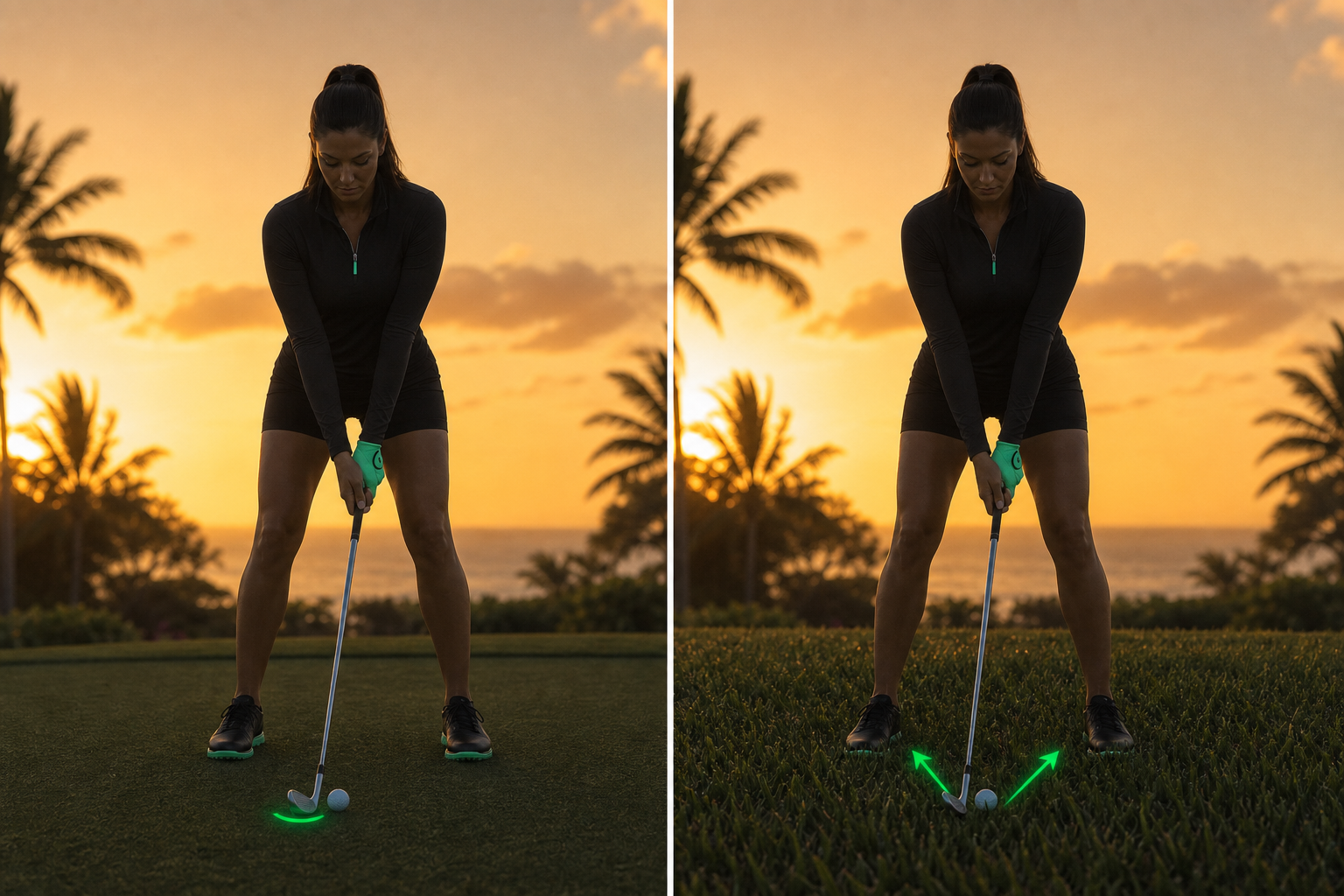
Setup Geometry
Calibrate from the Short Game Blueprint baseline, then tighten for friction:
- Club: Sand or gap wedge with enough loft for the carry window—do not add loft by flipping at impact.
- Face: Slightly open before grip — exposes bounce toward the turf (Geometry of Bounce).
- Handle: Neutral — not pressed forward. Excessive lean delofts and hides the skid plate.
- Stance: Narrow base, extra knee flex, ~55% lead-foot pressure — anchors forward low point without lateral sway.
- Ball position: Center to slightly back of center for a low checker; slightly forward only when a higher window is programmed (Trajectory Control).
Place a tee under the leading edge at address (practice only). If the tee knocks over during the swing, the edge dug before bounce skimmed — reset setup and shallow the U-path.
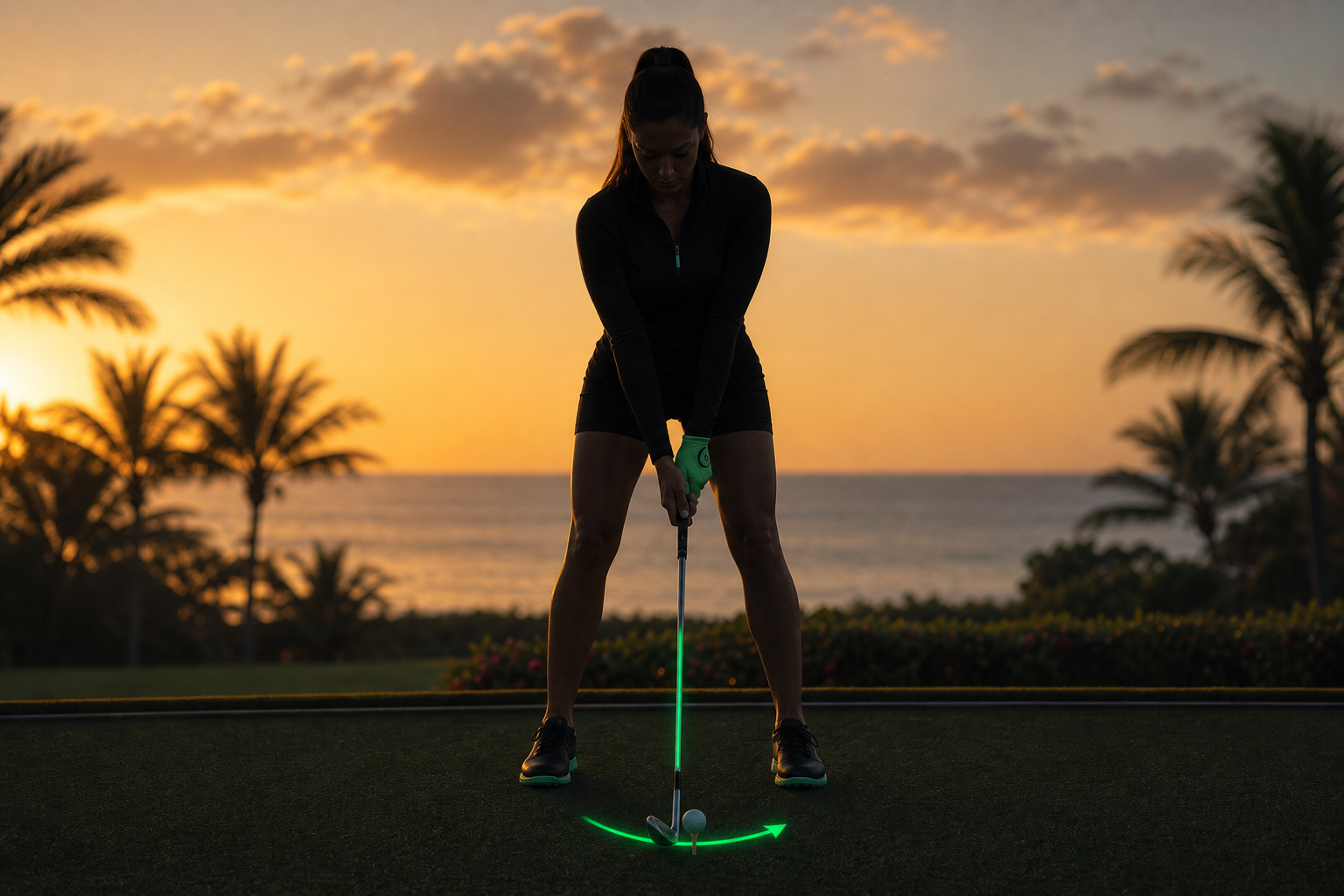
Execution: The Shallow U-Path
- The Mechanic: Rotate the chest through impact with relaxed arms — passive release, not hinge-and-hold.
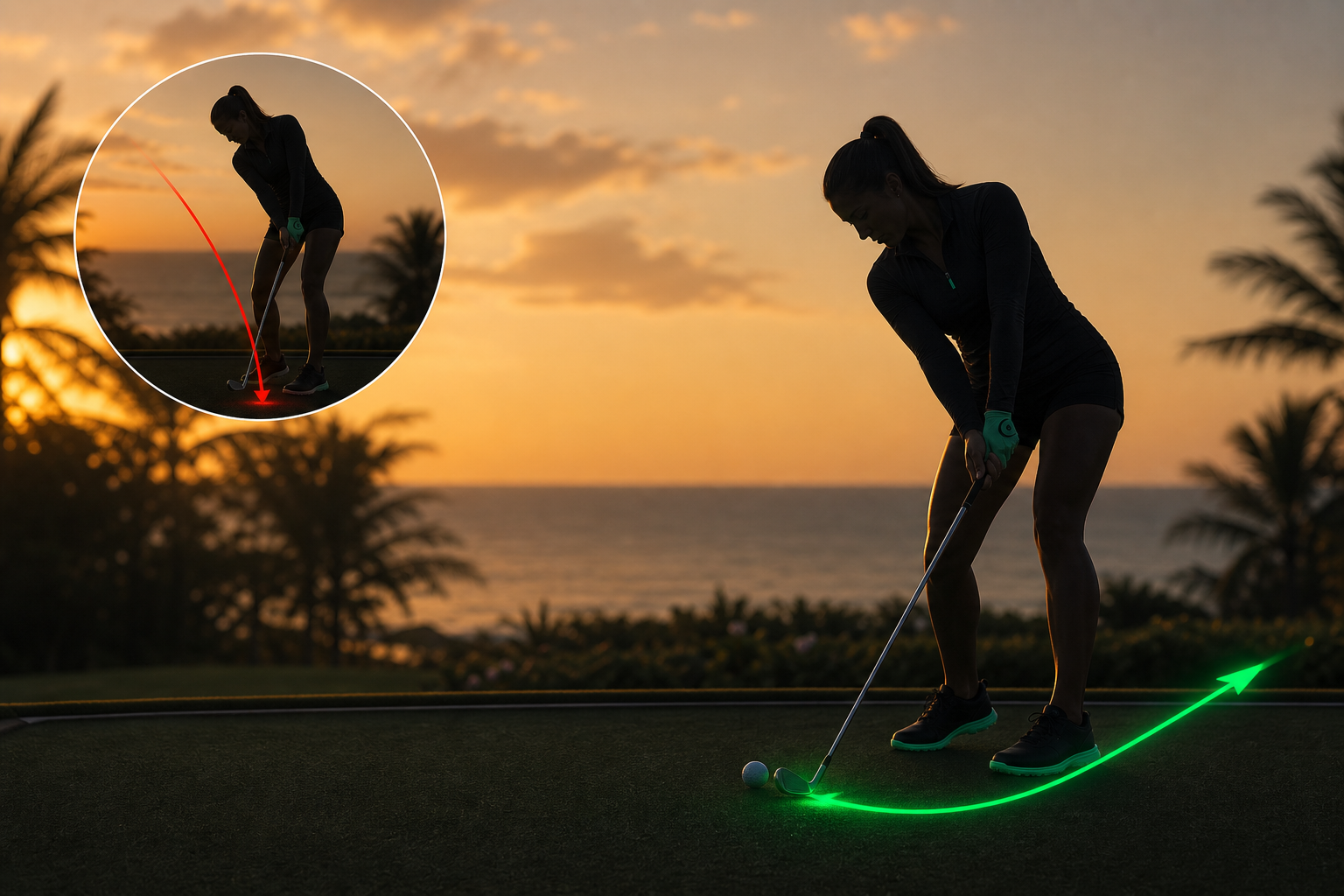
- The Path: Shallow U-shaped arc — sole skims the turf line; divot or bruise starts after the ball.
- The Audio: Hollow thump on skim (bounce working) vs. sharp thwack on dig (Geometry of Bounce).
- The Output: Ball-first contact with predictable low spin and controllable release on firm greens.
When a dig threatens, players lift the hub or flip the trail hand — producing blades across the equator. External focus stays on skim line or landing spot, not on lifting the ball.
Tight Lie vs. Other Windows
| Condition | Shot bias | Page |
|---|---|---|
| Tight lie + plenty of green | Low chip or Bump-and-Run | Rollout margin beats loft |
| Tight lie + no roll room | Low checker with committed speed | Trajectory Control |
| Fluffy lie | More carry, structural lead-hand tension | Trouble Shots — Heavy Rough override |
| Wrong club for distance | Clean skim, bad leave | Carry Calibration |
Full router: Short Game Shot Library.
Fault Signals
| Result | Likely cause | Fix |
|---|---|---|
| Chunk / dig | Forward lean + rigid hold | Neutral handle; Trail-Hand Chip Protocol |
| Blade / skull | Scoop or hub lift | Trajectory Control; stay on skim line |
| Good contact, wrong distance | Level not mapped | Carry Calibration |
On course: one external rule — landing spot or hollow thump — via Pre-Shot by Swing Category.
Grooving This Pattern
Grooving this pattern
Tight-Lie Chip
Primary drill
Tight-lie address and tee-under-leading-edge rehearsals (no ball) — maps in Learn It **Do**
Delivery rule
bounce skids, leading edge stays above the friction zone through impact.
Work through the three steps below in order—don't skip ahead.
If you get stuck
Trail-Hand Chip Protocol (Prove It passive release); The Geometry of Bounce (thwack replaces thump)
1. Learn It
~10% of your max · no ball
Address rehearsals on tight lie — neutral handle, open face, tee under leading edge dry swings
bounce skids, leading edge stays above the friction zone through impact. — map geometry at checkpoints; no rush. After each rep: Tee stays upright; U-path feels shallow; no forward handle press
2. Prove It
~30–70% of your max · ball on
add a ball; tee under leading edge + Trail-Hand Chip Protocol for 10 reps, then two-hand chips. Ball flight does not matter.
Ball-first contact; hollow skim audio; landing spot within 3 yards of target (8 of 10 reps)
The Geometry of Bounce if thwack replaces thump
3. Play It
Up to 100% of your max · game speed
game speed, new target/club/lie (or distance and break on putting), and the full Pre-Shot Loop when ready.
landing spot—not a body-part checklist
After any dig or blade, reset with Learn It tee constraint before the next ball
Bias Practice Plan weekly routing Short Game days toward tight-lie stations — not fluffy mat-only reps.
Live fault routing: Faults by Swing Category — Short Game · Short Game Shot Library.
The Cheatcode for your Game