The Geometry of Bounce
Final Boss Golf frames short-game execution differently than The Full Swing. Around the greens, raw velocity is a liability. Precision depends on low-point control and on how turf friction interacts with wedge sole geometry.
The Geometry of Bounce is the anti-chunk mechanism for tight lies, saturated turf, and heavy-friction conditions.
Wedge Sole Design
Wedges are specialized tools. The sole is not structurally flat:
- The leading edge sits higher.
- The trailing portion sits lower.
The angle between those edges defines Bounce. Bounce acts as a skid plate so the wedge glides over the top layer instead of digging into it.
The Leading Edge Fault
When short-game contact fails, it often comes from trying to swing the wedge like a steep iron compression strike:
- an aggressive Angle of Attack combined with
- forward shaft lean
That combination drives the sharp leading edge into the earth. The turf becomes a friction trap, decelerating the clubhead before impact and causing catastrophic energy loss.
When the leading edge contacts the turf before the ball is secured, the wedge digs. Contact fails whether the attempt is a steep chop or a scooping “lift.” The fix is to keep the leading edge elevated above the friction zone and let bounce do the work.
Kinematic Adjustment: Expose the Sole
To expose bounce correctly, players adjust setup so the wedge can skim:
- Neutralize shaft lean: Unlike full iron delivery, short-game setup benefits from a neutral handle position. Pressing the hands forward dynamically delofts the wedge and encourages digging.
- Open the face slightly: A small open setup increases effective bounce exposure by presenting more of the trailing edge to the turf.
- Widen the base: A slightly wider stance with extra knee flex lowers the center of mass and helps keep the delivery more stable.
- Lead-foot preload: Roughly 55% of pressure on the lead side at address anchors a forward low point and resists hanging back on tight lies.
For the full short-game setup model (grip, stance, pre-shot programming), see Short Game Blueprint.
Executing the Skid Plate
Once setup is locked, execution relies on flatter, more planar motion. Attempting to hit down with force will destroy the bounce geometry you just built.
Follow this exact 4-step execution sequence to glide the wedge through the turf.
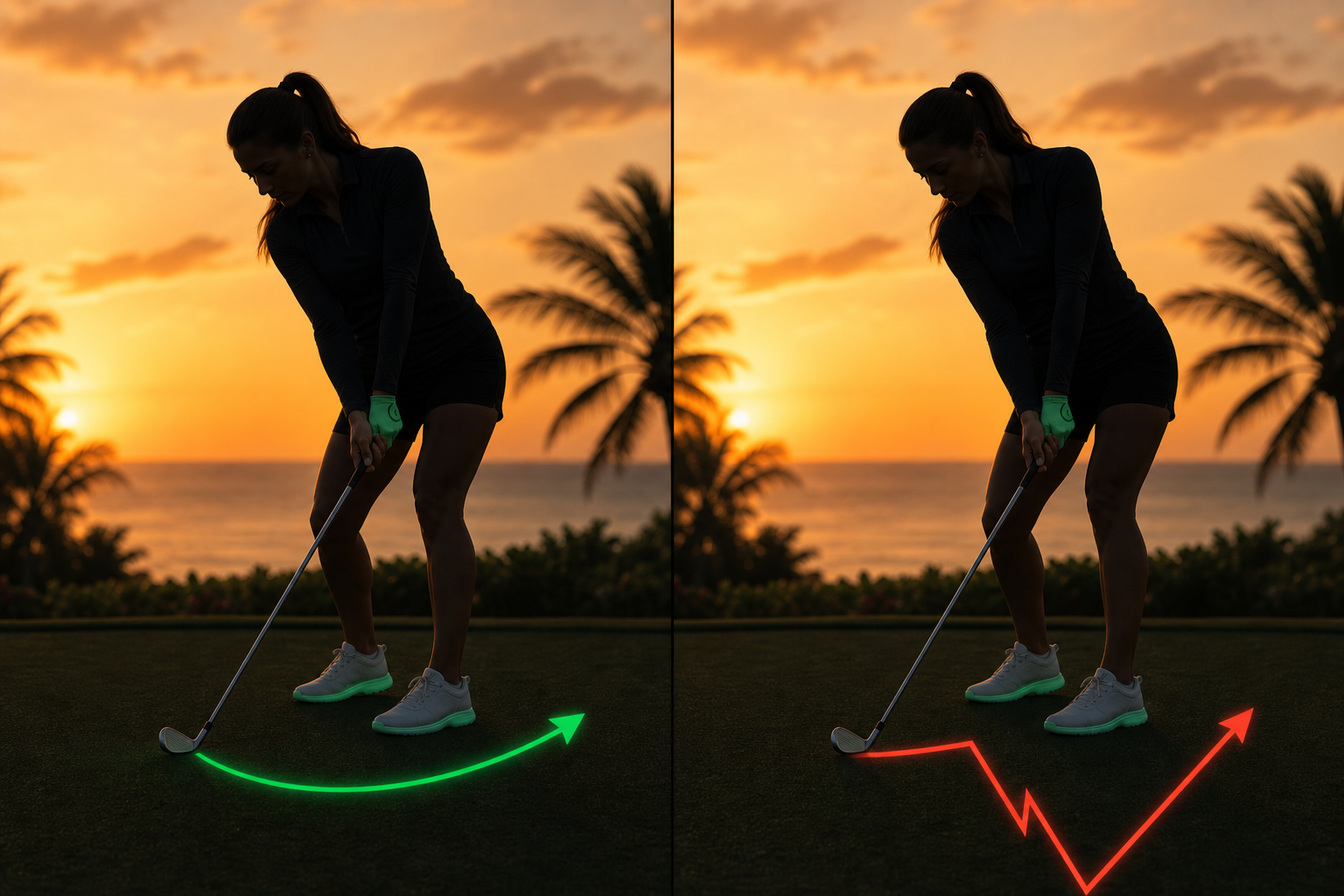
Step 1: The U-Shaped Delivery
You must abandon the steep, chopping motion common in iron compression.
- The Mechanic: The goal is a shallow, sweeping “U” rather than a steep “V” into the turf.
- The Output: By entering the grass at a shallow angle, the rounded sole of the wedge acts as a skid plate, allowing the clubhead to glide across the friction zone without snagging.
Step 2: The Passive Release
Do not try to aggressively drag the handle forward or hold rigid wrist angles.
- The Mechanic: Structural lag supports the wedge path. The clubhead is allowed to pass through the delivery window without forcing an abrupt, timing-based flip.
- The Output: The clubhead passes your hands smoothly, returning the shaft to a neutral position at impact. This ensures the bounce interacts with the ground first.
If you grip tightly and drag your hands heavily forward to "hold the lag", you dynamically deloft the face and drive the sharp leading edge straight into the dirt. See The Hinge-and-Hold Myth. Passive delivery requires zero forearm tension.

Step 3: Surface Interaction
You are not trying to excavate the golf course.
- The Mechanic: The objective is a slap/bruise of the grass layer under the ball, not an over-committed divot.
- The Output: The grass is simply clipped or slightly bruised as the bounce slides through the impact zone.

Step 4: The Acoustic Check
You can diagnose your execution immediately by the sound of the strike.
- The Mechanic: A well-exposed bounce strike produces a hollow “thump”.
- The Output: A digging strike tends to sound sharp “thwack” and causes heavy turf displacement.
Use sound at impact to confirm the friction outcome. If it thumps, the skid plate is working. If it thwacks, check your shaft lean and steepness.

Grooving This Pattern
Grooving this pattern
The Geometry of Bounce
Primary drill
Bounce setup and U-path dry rehearsals (no ball) — maps in Learn It **Do**
Delivery rule
neutral handle, open face, and a shallow U-shaped skim — not a steep leading-edge dig.
Work through the three steps below in order—don't skip ahead.
If you get stuck
Forehead Post & Tailbone Glide (hub sway or dip); tee-under-leading-edge constraint in Prove It
1. Learn It
~10% of your max · no ball
Setup and dry rehearsals — neutral shaft, slightly open face, wide base; trace the U-shaped path without turf contact
neutral handle, open face, and a shallow U-shaped skim — not a steep leading-edge dig. — map geometry at checkpoints; no rush. After each rep: Leading edge stays elevated; hands stay neutral; hub stays stable (Forehead Post & Tailbone Glide if sway or dip appears)
2. Prove It
~30–70% of your max · ball on
add a teed ball; place a tee or coin under the leading edge at address — the wedge must skim over it through impact without digging. Ball flight does not matter.
Hollow “thump” at contact and clean turf bruise — not ball-flight obsession (8 of 10 reps)
3. Play It
Up to 100% of your max · game speed
game speed, new target/club/lie (or distance and break on putting), and the full Pre-Shot Loop when ready.
sound and skim quality—not a body-part checklist
After a digging strike, reset with Learn It dry runs before the next ball
If contact turns sharp at Play It, drop back to Prove It and widen the open-face setup. Bounce must interact with turf before the leading edge — not the reverse.
Read next: Tight-Lie Chip · Short Game Shot Library