Bunker Shots: Sand Displacement
Final Boss Golf treats the greenside bunker as a separate strike problem: the wedge must miss the ball on purpose and enter the sand first. When full-swing turf-first logic is applied to sand, the wedge digs, the club decelerates, and the ball stays in the hazard.
The fix is sand displacement: use the Geometry of Bounce so the wedge glides through the friction zone and carries the ball out. Symptom routing: Short Game Shot Library · live faults: Faults by Swing Category.
The Sand Buffer (Physics of Impact)
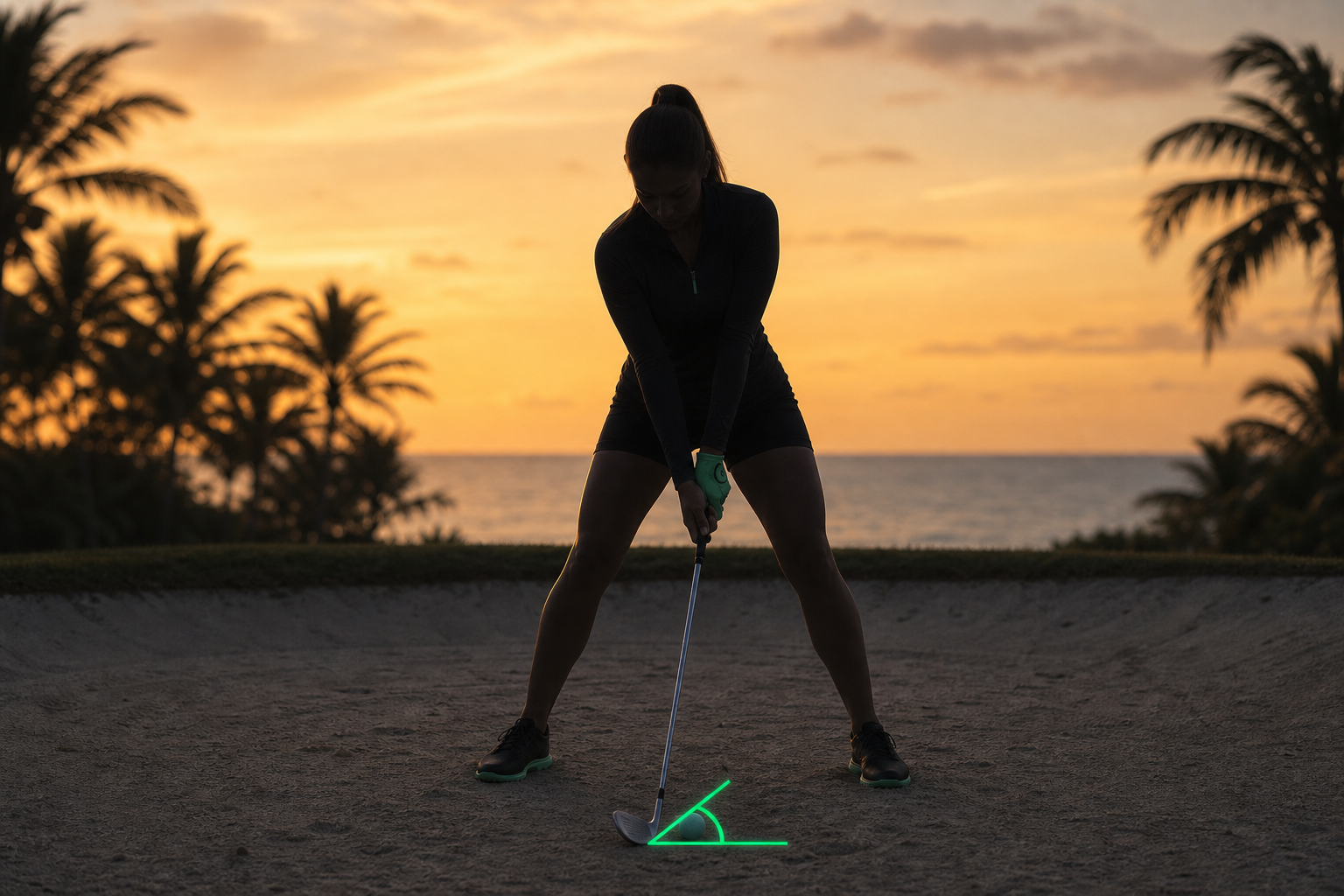
In bunker extraction, sand behaves like a kinetic buffer between the wedge and the ball. The target is a clubhead strike into the sand approximately two inches behind the ball.
- Kinetic energy transfer: Swing speed is converted into a displaced sand wave that lifts the ball.
- The extraction visual: Think of the ball as sitting in the center of a “dollar bill.” The goal is removing that entire “bill” with sand displacement.

Digging errors happen when the wedge leading edge drives too deep with a steep, steep, flat-plane angle of attack. Sand friction neutralizes clubhead speed, and the ball remains trapped. Bunker play requires exposing and using bounce so the sole can glide through the friction zone.

Calibrating the Setup Geometry
Final Boss Golf calibrates bunker setup to maximize loft, bounce exposure, and structural stability:
- Face angle calibration: Open the clubface wide before establishing grip. This exposes bounce toward the sand.
- Base stability: Use a wider stance than baseline and work the footwear into the sand to create a stable platform.
- Neutral handle coordinates: Keep hands neutral or slightly behind the ball at address. Forward shaft lean tends to reduce bounce effectiveness and invites digging.
- Spatial positioning: Place the ball slightly forward of center in the stance.
Executing the Kinematic Splash
Bunker extraction requires a fast rotation with a shallow, “U-shaped” delivery arc.
- High-velocity output: Sand absorbs most kinetic energy. A decelerating swing often fails to displace enough material. Practice targets around 80% to 90% of maximum rotational capacity.
- Surface interaction: Use Ground Reaction Forces to drive pressure into the lead foot, while maintaining shallow entry. The sole should “slap/splash” the sand surface rather than spear it.
- J-Curve finish: Do not stop the clubhead in the sand. Follow through fully and pull the handle “In and Up” through the J-Curve so the club exits the friction zone and completes the rotational arc.

In the practice facility, draw a physical line in the sand about two inches behind a row of golf balls. Repeat the displacement action so the club consistently lands the strike on the line, not on the ball.
Grooving This Pattern
Grooving this pattern
Bunker Shots
Primary drill
Open-face splash rehearsals in dry sand (no ball) — maps in Learn It **Do**
Delivery rule
strike sand two inches behind the ball with exposed bounce and committed speed — not ball-first contact.
Work through the three steps below in order—don't skip ahead.
If you get stuck
Line-in-sand entry constraint in Prove It; The Geometry of Bounce (wedge digs instead of splashes)
1. Learn It
~10% of your max · no ball
Open-face setup rehearsals and shallow U-shaped splash motions in dry sand without a ball
strike sand two inches behind the ball with exposed bounce and committed speed — not ball-first contact. — map geometry at checkpoints; no rush. After each rep: Wide base, neutral handle, face open before grip; sole slaps sand — no leading-edge spear
2. Prove It
~30–70% of your max · ball on
add a ball in the sand; line in the sand two inches behind the ball — club must enter on the line, not the equator. Ball flight does not matter.
Consistent sand entry point and full follow-through — not carry-distance obsession (8 of 10 reps)
The Geometry of Bounce calibration if the wedge digs instead of splashes
3. Play It
Up to ~90% of your max · game speed
game speed, new target/club/lie (or distance and break on putting), and the full Pre-Shot Loop when ready.
line entry and splash finish—not a body-part checklist
After a dig or decel, reset with Learn It dry splashes before the next ball
Sand absorbs energy — deceleration leaves the ball in the hazard. Commit to splash speed before adjusting setup.
The Cheatcode for your Game