Green Reading Algorithms
Final Boss Golf treats green reading as a data-collection problem. Visual-only reads are vulnerable to horizon tilt, background slopes, and optical bias. The approach prioritizes tactile sensing and a repeatable aim-point method.
Visual Parallax Distortion
The eyes are unreliable slope sensors. They often reference false horizons instead of gravity.
When slope is misread, most misses fall on the low side. A ball that passes below the apex of the break has near-zero probability of falling into the cup. The player needs a gravity-correct aim vector, not a visual guess.
The 3-Step Calibration Loop
Green reading is a data-collection problem. Your eyes are highly susceptible to visual parallax distortion, false horizons, and background slopes. To build a gravity-correct aim vector, you must transfer slope detection from your eyes directly to your feet.
Follow this exact step-by-step calibration sequence to map the topography and lock your aim point.
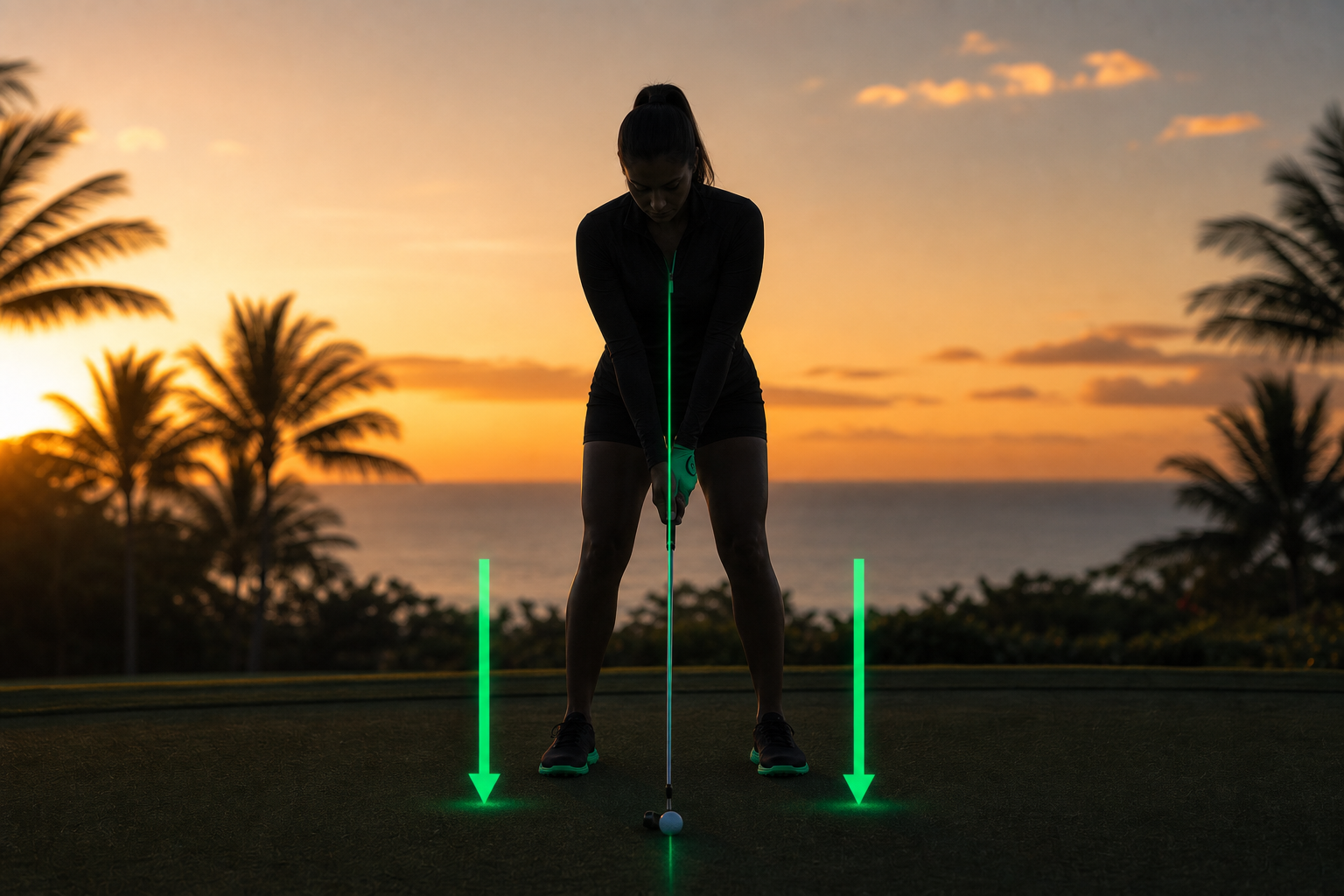
Step 1: Sensor Calibration (Straddle the Line)
You must shut down the visual noise and rely entirely on gravity and balance.
- The Mechanic: Walk to the midpoint of your putt and stand with the intended start line directly between your feet. Close your eyes briefly to completely shut down visual bias.
- The Output: Without your eyes lying to you, your inner ear and physical balance will immediately tell you which foot holds more pressure and where gravity wants to pull your mass. You now know exactly which way the putt breaks.
Step 2: Assign a Slope Value
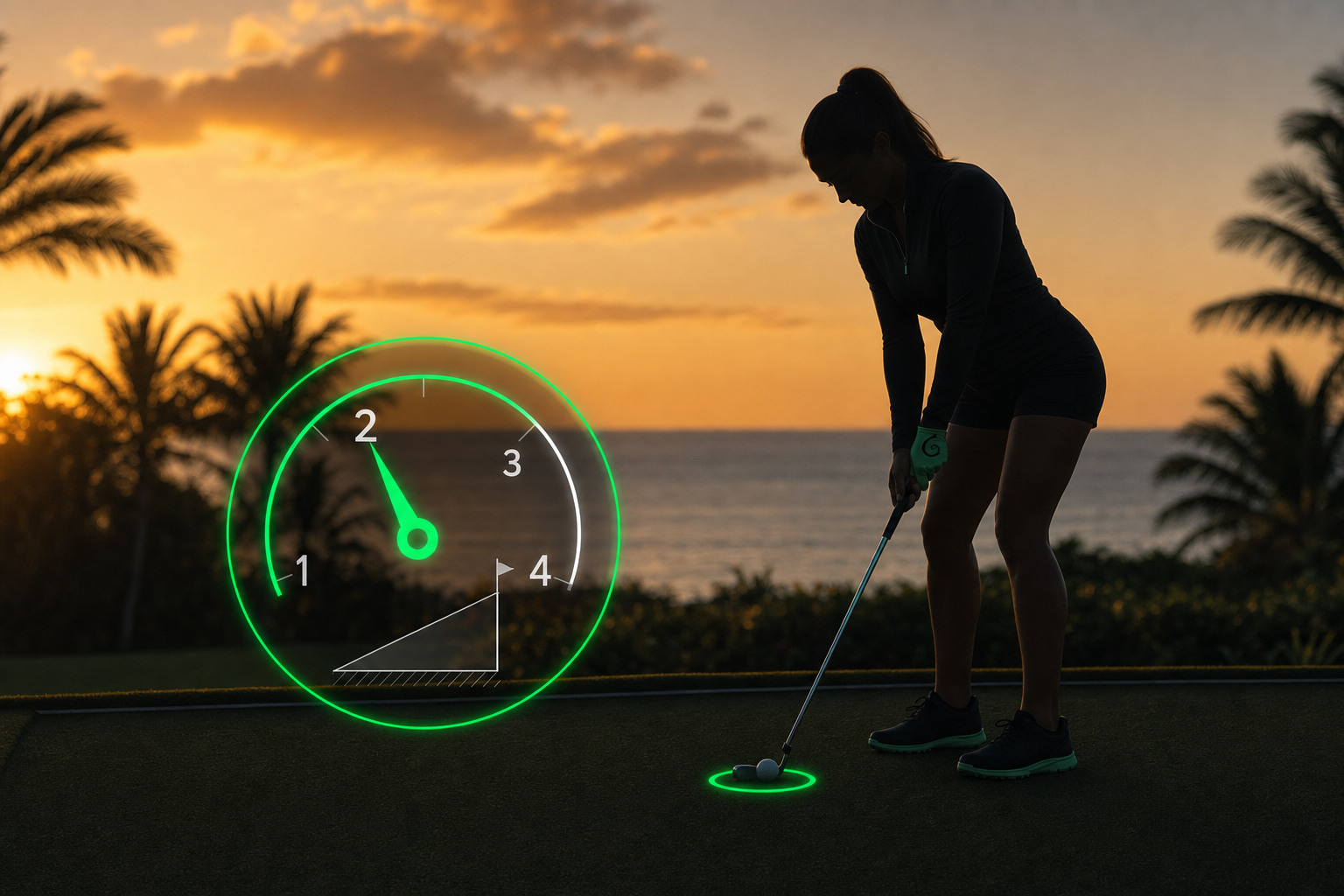
You cannot program a system using vague terms like "it breaks a little." You must assign a hard integer.
- The Mechanic: Based on the pressure you felt during the straddle calibration, use a strict 1 to 4 scale to quantify the slope.
- 1: Barely perceptible
- 2: Standard tournament slope
- 3: Severe
- 4: Extreme / near max legal pitch
- The Output: You now have a mathematical variable to plug into your aim equation, stripping away the guesswork.
Step 3: Set the Aim Point (The Finger Vector)
Now you take your slope integer and convert it into a physical coordinate on the green.
- The Mechanic: Walk back behind the ball. Hold one hand up at arm’s length and align the edge of your finger perfectly with the center of the cup. Next, offset your aim point by counting "one finger per slope value" in the direction of the break.
- The Output: If you assigned a slope value of 2, you shift two fingers over. The outside edge of that last finger becomes your exact Target Coordinate.
When slope is misread, most misses fall on the low side. A ball that passes below the apex of the break has a near-zero probability of falling into the cup. Trust your foot-sensor data and commit to the higher Target Coordinate.

Step 4: The Execution Lock
Your read is complete. Do not re-evaluate the break once you step over the ball.
- The Mechanic: Step into your stance and lock your putter face directly to your new Target Coordinate. This algorithm assumes a baseline delivery speed where the ball will finish about 12 inches past the hole.
- The Output: You are no longer putting to the hole; you are putting to a defined coordinate in space. Execute the stroke.
Once the Target Coordinate is selected, the read is complete. Your only job is launching the ball over that coordinate with the programmed speed from Speed Programming. If doubt creeps in during the stroke, the read failed before address.

Grooving This Pattern
Grooving this pattern
Green Reading Algorithms
Delivery rule
feet detect slope, eyes assign the aim vector — then execute with programmed speed, no mid-stroke read changes.
Work through the three steps below in order—don't skip ahead.
1. Learn It
No stroke · map the read only — 10% Speed Protocol
Straddle-line sensor drills — eyes closed at midpoint, feel pressure shift, assign slope value 1–4
feet detect slope, eyes assign the aim vector — then execute with programmed speed, no mid-stroke read changes. — map geometry at checkpoints; no rush. After each rep: Tactile read locked before addressing the ball; no visual re-guess at setup
2. Prove It
Slow rehearsal tempo · ball on
add a ball on the practice green.
Full 3-step loop on every putt — straddle, slope value, finger-vector aim point; roll with Speed Programming Level matched to distance (8 of 10 reps)
Face Angle vs. Path gate calibration if misses fall low-side despite a correct read
3. Play It
Same tempo · game-speed read → commit → stroke
game speed, new target/club/lie (or distance and break on putting), and the full Pre-Shot Loop when ready.
Full read loop plus pre-shot routine on every putt; commit to Target Coordinate before stroking; change putt every rep—not a body-part checklist
After a low-side miss, re-run straddle calibration — do not adjust aim visually mid-round without a new loop
If doubt creeps in during the stroke, the read failed before address. Reset with Learn It straddle sensing, not a last-second aim tweak.
The Cheatcode for your Game