The Planar Pendulum
Final Boss Golf treats putting as a different swing category. The Full Swing rewards 3D torque and spiral delivery. Putting rewards the opposite: removing degrees of freedom until the stroke behaves like a simple planar pendulum—one plane, shoulder-driven, no full-swing body bleed.
The goal is a stable chassis, a locked upper triangle, and a shoulder-driven arc that keeps the face predictable through impact.
The Full-Swing Bleed Fault
Most putting inconsistency is self-inflicted. Players bring full-swing variables into a micro-stroke:
- excess body rotation
- hip action
- active wrist hinge and face fanning
Those variables add face-angle variance at precisely the moment the margin for error is smallest.
If wrists hinge or rotate the face open during the backstroke, the stroke is running a full-swing routine in a planar environment. The putter then needs timing-based closure to square the face at impact. Recalibrate away from wrist hinge—do not layer a new “fix” on top of the same fault.
Grip: Eliminate the Hinge
Putting grip styles (reverse overlap, wrist-lock, or claw) share one objective: no active wrist hinge through the stroke. Pressure stays light and even so the shoulders can rock the upper triangle without hand rescue at impact. Full putting setup geometry—including stance as a distance gauge—is in the Putting Blueprint.
Follow this step-by-step calibration sequence to build a shoulder-driven arc that keeps the putter face predictable through impact.
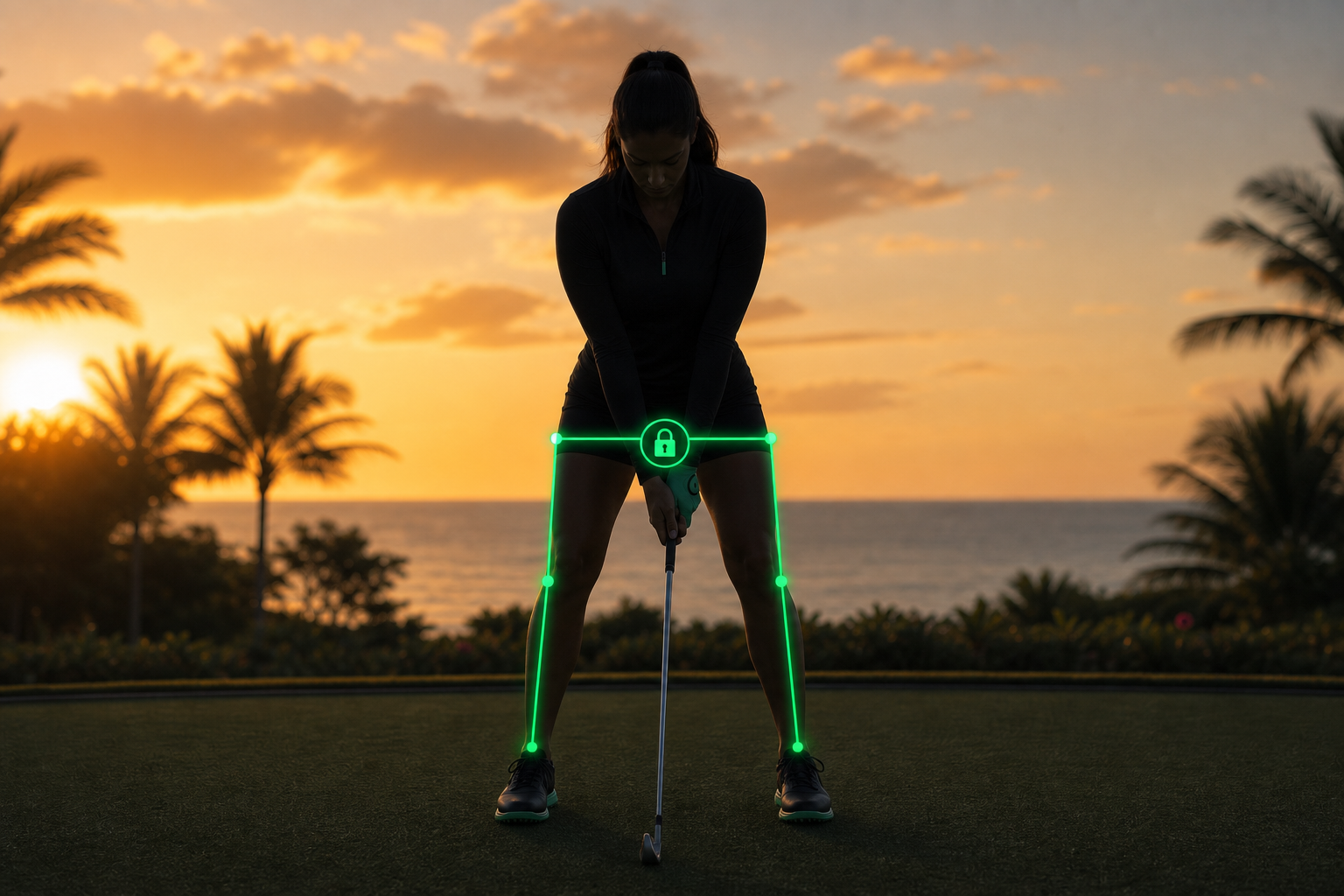
Step 1: Stabilize the Chassis
You must build an immovable anchor.
- The Mechanic: Your legs and hips must remain entirely quiet and stable. There is absolutely no Ground Reaction Force (GRF) thrust applied here—only structural stillness.
- The Output: By freezing the lower body, you prevent the central hub from swaying, ensuring the putter always bottoms out in the exact same spatial coordinate.
Step 2: Lock the Upper Triangle
Putting grips vary, but their singular objective is eliminating active wrist hinge.
- The Mechanic: Form a rigid triangle using your shoulder line and your arms. Keep your grip pressure light and even, ensuring your wrists remain completely "dead".
- The Output: This locked triangle becomes your new swing hub. Without active wrists fanning the club open or closed, you eliminate the need for a timing-based rescue at impact.

Step 3: Spatial Calibration
Your setup geometry dictates your ability to see the line without distortion.
- The Mechanic: Position your eyes close to (or slightly inside) the ball line to reduce visual parallax distortion. Align your feet, hips, and shoulders perfectly parallel to your start line.
- The Output: Your physical alignment perfectly matches your intended vector, setting the stage for a planar stroke.

Step 4: Execute the Planar Arc
With the chassis stable and the triangle locked, motion is driven entirely by the upper body.
- The Mechanic: Rock the upper triangle back and through using only your shoulders.
- The Output: Human anatomy naturally produces a slight arc, but your objective is planar control. By minimizing unnecessary body rotation, the face remains highly stable relative to your target line.
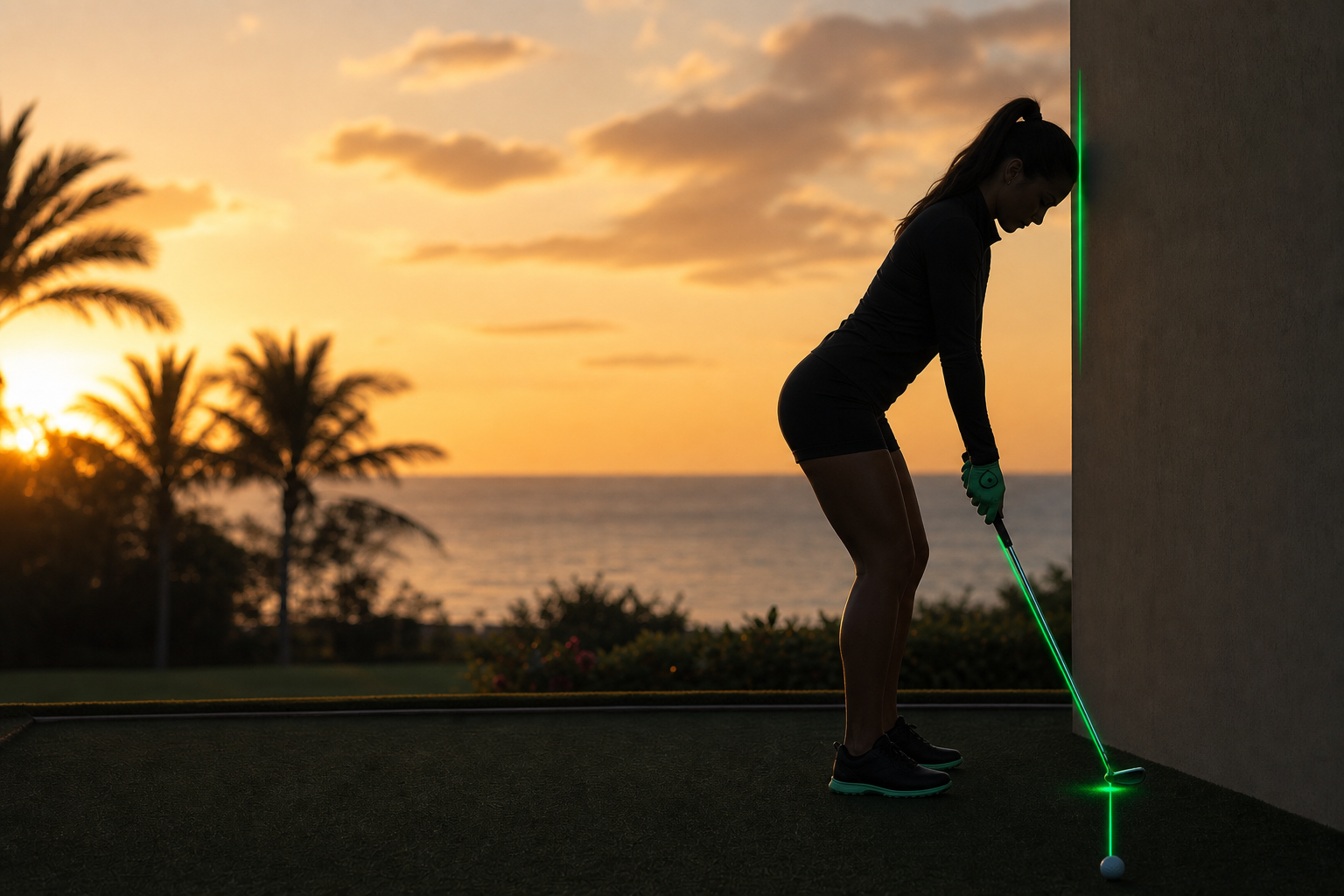
Step 5: The Wall Constraint Test
Verify that full-swing body motion is not bleeding into the planar stroke.
- The Mechanic: Stand with your head gently touching a physical wall constraint and execute your putting strokes.
- The Output: If your head rubs or shifts against the wall, extra body motion is corrupting the pendulum. If your head stays perfectly quiet while the shoulders rock, the planar pendulum is officially calibrated.
Output
Putting reduces to a simple equation: Start Line + Speed = Cup. The planar pendulum is the face-stability module that protects the start-line variable.
Grooving This Pattern
Grooving this pattern
The Planar Pendulum
Primary drill
Wall constraint strokes (no ball) — maps in Learn It **Do**
Delivery rule
quiet lower body, locked upper triangle, and shoulder-driven motion — no active wrist hinge.
Work through the three steps below in order—don't skip ahead.
If you get stuck
Forehead Post & Tailbone Glide (head or body bleed in Prove It)
1. Learn It
Constant metronome tempo · Level 1 stroke length · no make goal — 10% Speed Protocol
Wall constraint strokes — head gently on wall, shoulders rock the triangle back and through without head shift
quiet lower body, locked upper triangle, and shoulder-driven motion — no active wrist hinge. — map geometry at checkpoints; no rush. After each rep: Wrists stay dead; hips and legs remain still; stroke stays planar
2. Prove It
Same tempo · Levels 1–3 · ball on
add a ball; wall or Forehead Post & Tailbone Glide — any head or body bleed breaks the pendulum. Ball flight does not matter.
Quiet chassis and repeatable shoulder arc — not hole-out obsession (8 of 10 reps)
3. Play It
Same tempo · game speed
game speed, new target/club/lie (or distance and break on putting), and the full Pre-Shot Loop when ready.
head stillness and shoulder rhythm—not a body-part checklist
After wrist hinge or body motion appears, reset with Learn It wall strokes before the next putt
If the face wanders at Play It, drop back to Learn It. Start-line training fails when full-swing body motion re-enters a planar stroke.
Read next: Face Angle vs. Path · Start-Line Gate Protocol · Speed Programming
The Cheatcode for your Game