The J-Curve Hand Path: Decoding the Release
Final Boss Golf treats two-way misses (hooking and slicing) as release-geometry failures inside The Full Swing. When the hands attempt a straight-line path toward the target, the club loses the centrifugal conditions required for stable face control. The face then needs a last-second wrist timing closure, which creates inconsistency.
Elite kinematics replace flat-plane “straight-line delivery” with a curved hub path: the J-Curve.
The J-Curve Geometry (In and Up)
In the Final Boss Method, the hands are the hub and the clubhead is the satellite. The hub follows an "In and Up" vector:
- Descent: Early transition drops the hands into the delivery zone.
- Hook of the J: As the body clears and the lead shoulder elevates away from the target, the hub pulls inward (toward the left) and upward.
A linear hub path deprives the clubhead of centrifugal force needed for stable face control. Players then force a manual wrist roll to close the face, turning the release into a timing contest.
Parametric Acceleration (Why Curvature Creates Speed)
The J-Curve changes the effective radius at the hub. With angular momentum in play, contracting the radius increases rotational speed. The result is more clubhead velocity without arm-chasing.
When the hub moves through the J-Curve, centrifugal force drives the clubhead outward and squares the face automatically through impact. Manual wrist manipulation becomes optional—provided the wrist structure was matched at the top. Face control is the output of 3D path geometry, not a roll at the bottom.
Powering the Path with Ground Reaction Forces
To generate elite clubhead speed and trace the proper J-Curve, you cannot rely on your arms. Pulling the handle "In and Up" solely with your upper body creates a disconnected, weak swipe. True parametric acceleration requires the 3D Power Grid. The ground supplies the force; your hands simply direct the geometry.
Here is the exact step-by-step calibration protocol to map the connection between Ground Reaction Forces (GRF) and the J-Curve path. This sequence installs the geometry from the ground up, structured with visual asset prompts for your Docusaurus site layout.
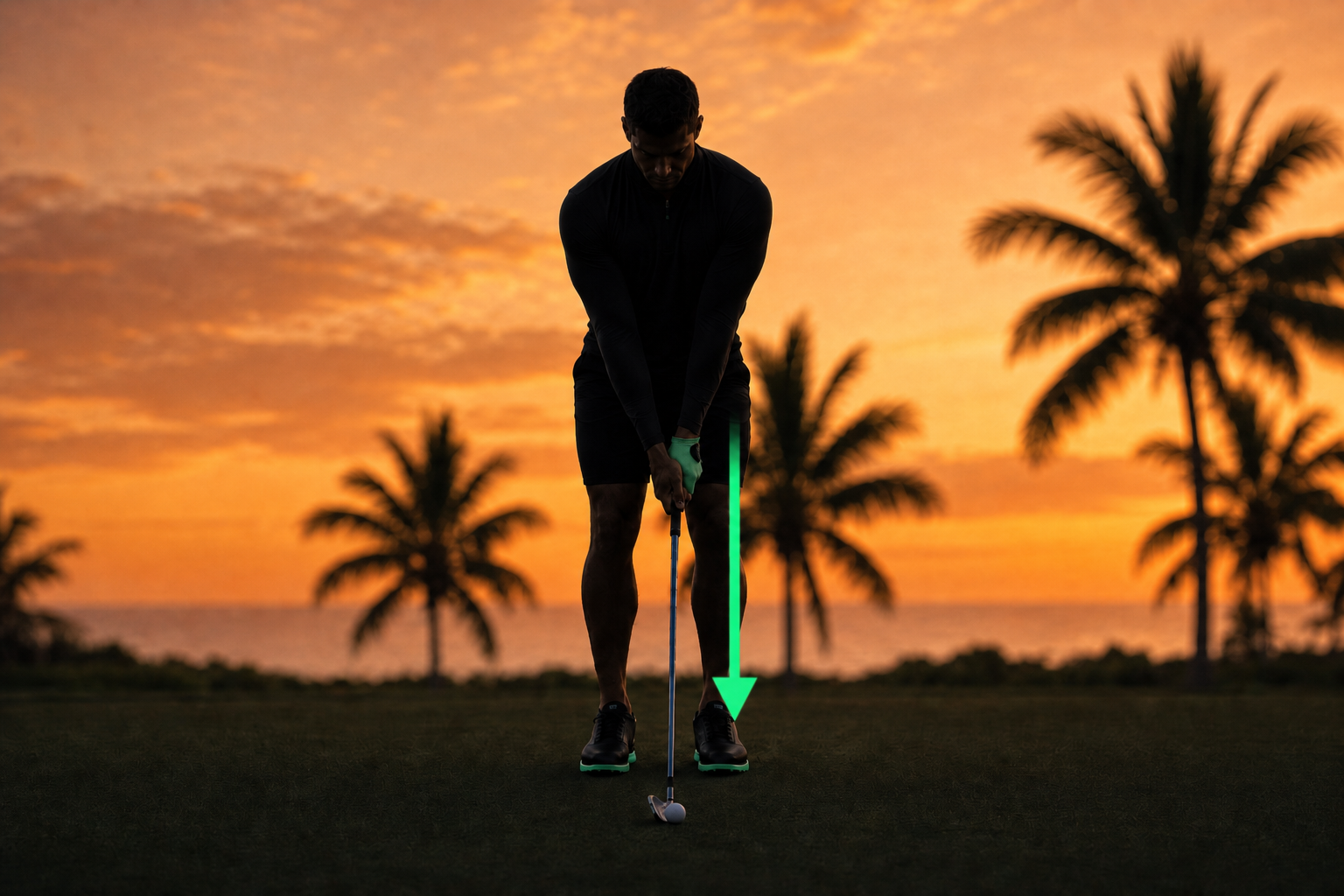
Step 1: The Lead-Foot Anchor (Load)
Before you can pull the handle upward, you must establish an anchor point to push off of.
- The Mechanic: As you transition into the downswing, shift your pressure and drive mass heavily into your lead foot. You are compressing the earth beneath your lead shoe.
- The Output: This downward force stabilizes your central hub and coils the lead leg, priming it to fire. Without this anchor, any attempt to pull the hands upward will result in your entire body swaying off the ball.
Step 2: The Vertical Spring (Elevation)
You cannot pull the handle "Up" if your body is moving "Down." The earth must push back.
- The Mechanic: Repel the ground. Violently extend your lead leg, driving your lead hip upward and backward in space.
- The Output: As your lead hip elevates, it acts like a pulley system attached to your lead shoulder. The shoulder rises, which naturally begins dragging the handle of the club upward.
If your lead knee remains deeply flexed through impact and your pelvis simply spins horizontally, you have zero vertical force. The handle will stay low, the J-Curve path collapses, and you will likely hit a heavy chunk or force a desperate wrist flip.

Step 3: The Kinematic Pull (In and Up)
With the vertical spring firing, you must now direct the handle through the delivery corridor.
- The Mechanic: Allow the rotation of your torso and the elevation of your lead shoulder to physically drag your hands In and Up toward your lead ribcage.
- The Output: Your hands are not pushing toward the target. They are ripping inward, tightening the radius of your swing hub.

Step 4: Parametric Acceleration (The Whip)
This is where the physics of the J-Curve pay off. By pulling the hands inward, you trigger parametric acceleration.
- The Mechanic: Maintain the structural tension of the "In and Up" pull while letting the clubhead release outward. Do not try to manually square the face with your wrists.
- The Output: As the handle pulls tightly inward, centrifugal force violently ejects the heavy clubhead outward along the Elbow Plane. The face automatically squares itself through the 3D spiral without requiring any micro-second timing from your forearms.
Think of a spinning figure skater pulling their arms inward to exponentially increase their rotational speed. By pulling the handle tight to your body (In and Up) while the clubhead fires outward, you multiply your speed to maximum terminal velocity just as the face meets the ball.

Grooving This Pattern
Grooving this pattern
The J-Curve Hand Path
Primary drill
Slow J-Curve mirror rehearsals (no ball) — hub In and Up; maps in Learn It **Do**
Delivery rule
hub **In and Up**, not a straight-line push at the target.
Work through the three steps below in order—don't skip ahead.
If you get stuck
The Exit Gate Station (Prove It constraint); The Split-Grip Station (wrist flip persists)
1. Learn It
~10% of your max · no ball
Mirror rehearsals and slow dry runs — trace the hook of the J at impact height; hold the hub inward and upward through the release zone
Hub **In and Up** through the release zone—trace the J hook at impact height, not a push at the target. After each rep: Lead shoulder elevates; hands pull In and Up; no linear chase toward the target
2. Prove It
~30–70% of your max · ball on
add a teed ball; The Exit Gate Station — block the linear exit past the ball so the hub must track the J-Curve. Ball flight does not matter.
Exit gate clearance—the hub must finish on the J, not linear past the ball
The Split-Grip Station if wrist flip persists and face control still depends on timing
3. Play It
Up to 100% of your max · game speed
game speed, new target/club/lie (or distance and break on putting), and the full Pre-Shot Loop when ready.
gate clearance or start-line—not a body-part checklist
After a breakdown, reset with a calibration swing — do not rush into the next ball
If the hub stalls linear at Play It, drop back to Learn It and rehearse lead-foot vertical force before adding speed. The J-Curve is a ground-force output, not an arm fabrication.
The Cheatcode for your Game