Ground Reaction Forces: Power from the Turf
The traditional golf industry has fed beginners a fatal lie: that swing speed comes from swinging your arms faster. Final Boss Golf rejects that. Elite clubhead velocity is not generated by the upper body; it is a mathematical output of how aggressively you interact with the turf. Final Boss Golf calls this Ground Reaction Forces (GRF).
The ground supplies the power; upper-body effort mainly delivers the club.
The 3D Power Grid
Outdated flat-plane instruction often reduces speed to vague "weight shift" or turning cues. Final Boss Golf treats GRF as a 3D sequence that must fire across three specific vectors.
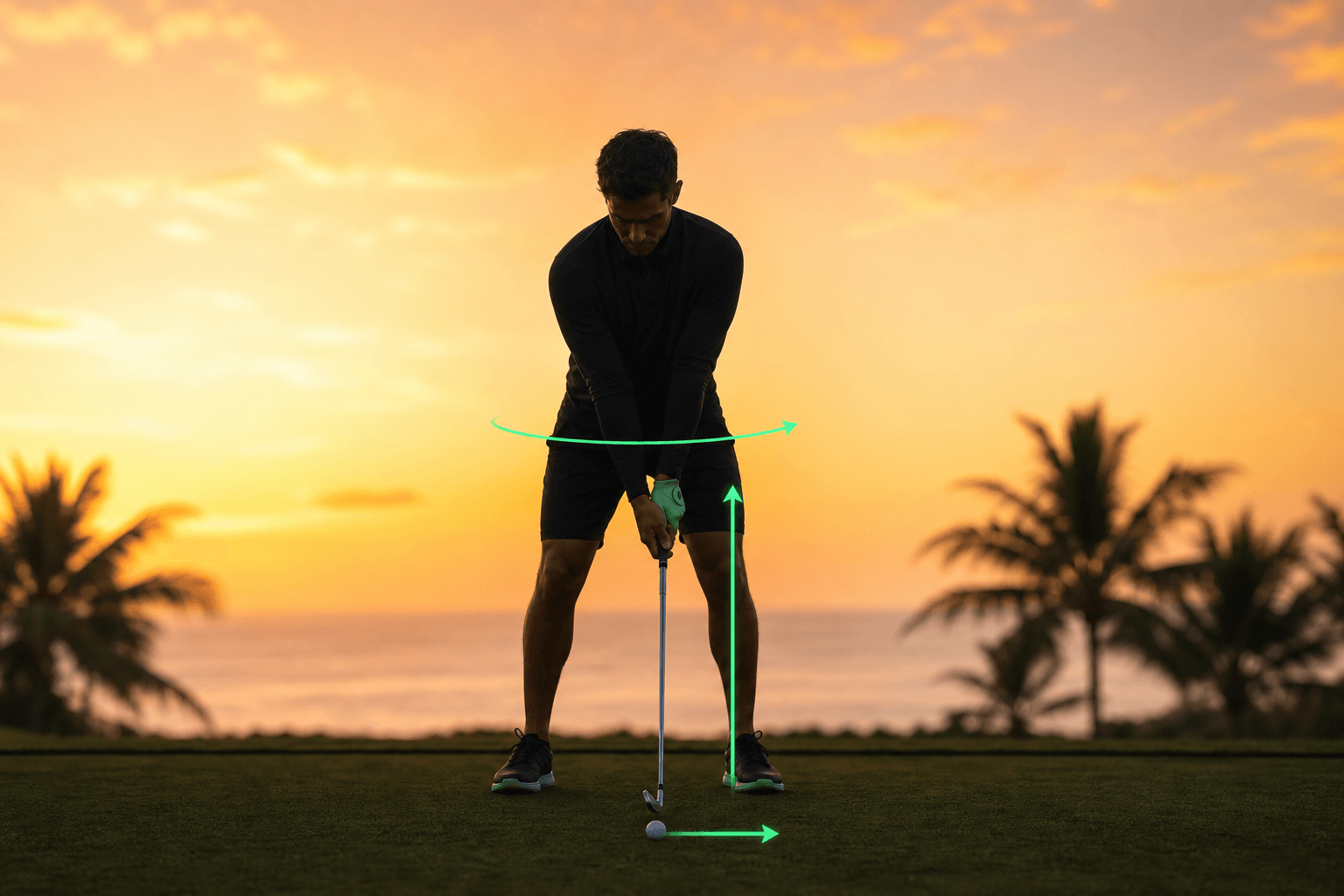
- Horizontal Force (Linear Shift / Re-centering): Transition shift away from the target, followed by an early re-centering toward the lead side before the backswing fully completes.
- Torque (Rotational Shear): Opposing shear under the lead and trail feet creates rotational velocity and clears the hips.
- Vertical Force (Elevation): Pressure into the lead foot drives vertical force upward, spiking lead-side extension and catalyzing clubhead acceleration through impact.
When lateral motion replaces torque and vertical force, rotation stalls. The body slides past the delivery zone, and face control gets rescued with a timing-based wrist flip.
The Step-Up Protocol
To learn how to tap into the 3D Power Grid, Final Boss Golf does not start with a driver or an all-out swing. The Step-Up Protocol strips away the club, removes the ball, and isolates the lower body kinematics — field version: Step-Up Drill.

Use a mid-iron, and focus entirely on the feet.
Step 1: The Narrow Setup
To feel the transfer of mass, the narrow setup removes the wide, stable base.
- The Mechanic: Feet close together at address. The club hovers behind an imaginary ball line. The upper triangle of the arms and shoulders is relaxed.

Step 2: The Early Re-Center (Horizontal Force)
Range wisdom shouts "shift your weight." That usually causes a lateral sway. Final Boss Golf trains a dynamic step.
- The Mechanic: Start the backswing. Before the hands reach the apex, lift the lead foot and step forward to a normal stance width. The lower body moves forward toward the target while the upper body is still loading back.

Step 3: The Stomp (Load)
You cannot fire a cannon from a canoe. The transition must be anchored into the earth before rotation begins.
- The Mechanic: As the lead foot lands from the step, drive massive downward pressure into the turf. This is the "stomp." It anchors the transition and loads the lead leg like a coiled spring.

Step 4: Verticle Post (Elevation)
This is where the speed is created. The ground pushes back.
- The Mechanic: Repel the ground. The lead leg violently extends, pushing the lead hip backward and upward. That vertical vector clears the body out of the way and whips the arms through the delivery zone (The J-Curve).
You should feel your belt buckle physically elevate during this step. If the lead knee stays flexed and the torso dives toward the turf, verticle post has failed. The step establishes a post to push off—not permission to slide the upper body forward.
Grooving This Pattern
Grooving this pattern
Ground Reaction Forces
Primary drill
Delivery rule
Torque and vertical force from the ground before the arms accelerate.
Work through the three steps below in order—don't skip ahead.
If you get stuck
The Wall Walk (Early extension or pelvis thrust), Forehead Post & Tailbone Glide (sway or dip)
1. Learn It
~10% of your max · no ball
The Step-Up Drill Dry runs—narrow stance, early lead-foot step, stomp load, verticle post through impact height.
Early lead-foot step, stomp load, and verticle post through impact height. After each rep: Lead foot anchors transition; lead hip elevates on verticle post; spine hub stays stable—no lateral upper-body sway
2. Prove It
~30–70% of your max · ball on
Add a teed ball—the stomp-and-post must finish *before* the club reaches impact. Ball flight does not matter.
Stomp-and-post finishes before the arms reach the ball—the teed ball is proof, not the scorecard
The Wall Walk For early extension or pelvis thrust; Forehead Post & Tailbone Glide for sway or dip.
3. Play It
Up to 100% of your max · game speed
Game speed, new club and target every rep, and the full Pre-Shot Loop when ready.
Lead-foot stomp or vertical finish—not a body-part checklist.
After a mishit, one slow Learn It Step-Up Drill dry rep—re-anchor stomp and verticle post before the next ball.
If speed stalls at Play It, drop back to Learn It and rebuild the stomp-and-post sequence at 10%. Clubhead velocity is a ground-force output—never an arm-speed input.
The Cheatcode for your Game