Curing Early Extension: Pelvic Kinematics
Inconsistent contact, blocks right, and timing-based hooks often trace to early extension—a common movement fault where the pelvis thrusts toward the ball in the downswing, stealing space the arms need and forcing last-second compensations.
Early extension is usually a defensive response to an earlier geometry failure—not a primary mistake in isolation. Often follows over-the-top steep delivery or flying elbow disconnect.
Trains
- Ground Reaction Forces — re-center and clear without thrust toward ball
- The Elbow Plane — shallowing removes need to stand up
- The J-Curve Hand Path — In-and-Up needs pelvic depth preserved
- Related faults: over-the-top slice, stuck block/hook, fat/chunk
Root Causes
1) Steep Shaft (Flat-Plane Error)
A steep transition puts the club on a collision course with turf behind the ball. The body stands up and thrusts forward to shallow the strike artificially.
Tactical correction: shallow onto the Elbow Plane before expecting pelvic stability.
2) Loss of Depth (Y-Axis)
Rotation needs clearance between pelvis and ball. If glutes leave their depth at address during the backswing or early downswing, arms trap behind the lead hip.
3) Sequencing (Spin-Out)
Rotating the pelvis horizontally from the top without loading GRF drags the trail hip toward the ball and triggers extension—a breakdown in the kinematic sequencing Fundamental.
"Stay down" with a thrusting pelvis increases spinal compression. Fix pelvic depth and sequencing; posture follows.
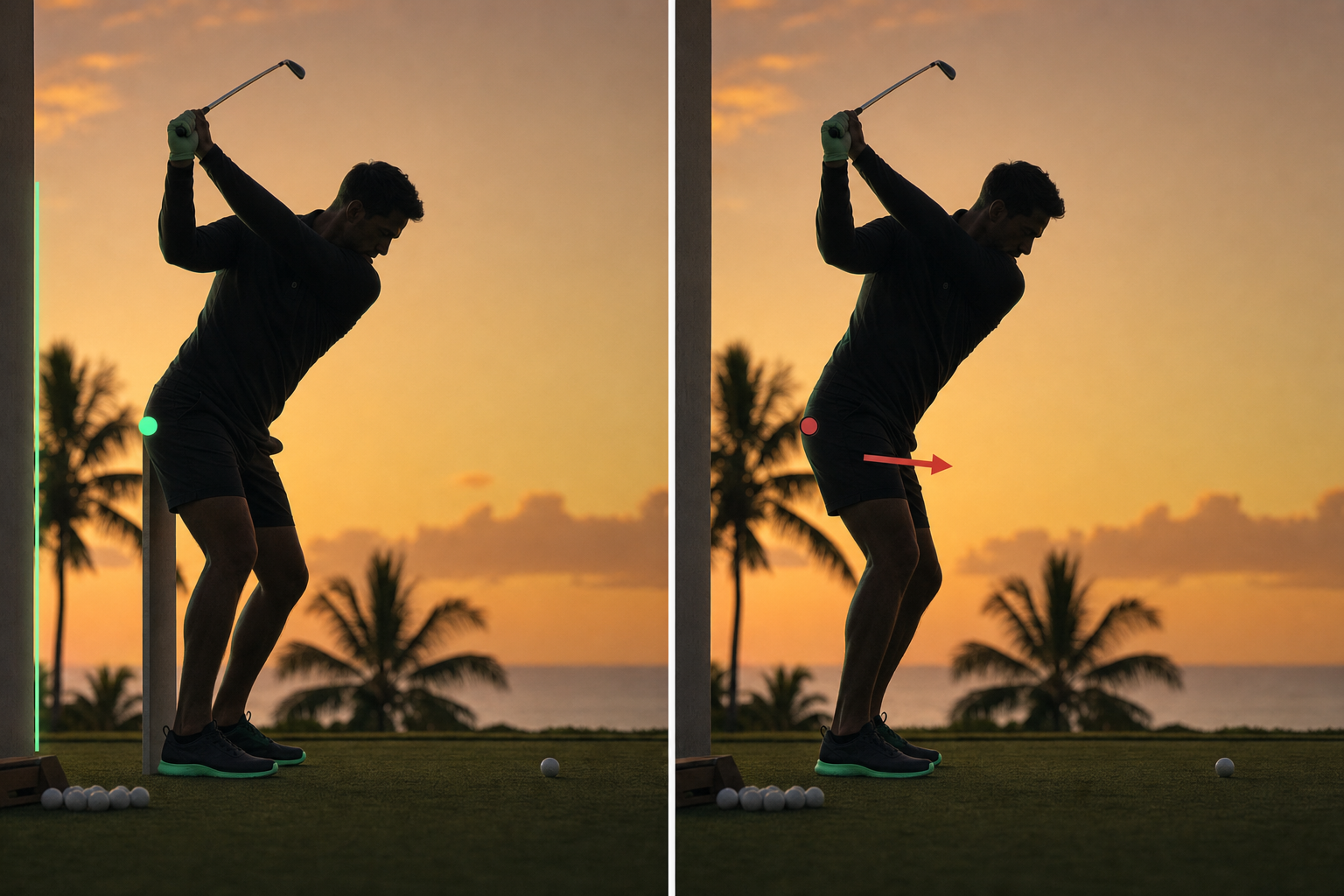
Movement Patterns
Run at 10% speed first.
- Wall Walk: 3-step pelvic loop; tailbone stays on wall through clear
- Forehead Post & Tailbone Glide: hub + tailbone depth before full wall walk
- Pump Drill: shallowing after depth is mapped — removes steep-collision threat
- Plane Station Connector: ceiling rod when OTT co-occurs
- Bag constraint: rod ~1 inch behind trail glute at address — must stay through downswing
Progression
- Forehead Post & Tailbone Glide — hub stable
- Wall Walk — map depth and clear
- Pump Drill — shallow under ceiling
- Progressive Chaining at 30%+
If OTT persists after depth holds, address shallowing before adding speed.
Grooving This Pattern
Grooving this pattern
Curing Early Extension
Primary drill
Delivery rule
pelvis depth and wall clearance through delivery.
Work through the three steps below in order—don't skip ahead.
If you get stuck
The Pump Drill (Prove It shallowing without upper-body throw)
1. Learn It
~10% of your max · no ball
10 Wall Walk cycles; tailbone on wall through Step 3 clear
pelvis depth and wall clearance through delivery. — map geometry at checkpoints; no rush. After each rep: No thrust toward ball; trail glute bag constraint stays put
2. Prove It
~30–70% of your max · ball on
add a mid-iron near the wall at 10–30% of your max; pair Pump Drill in the same session. Ball flight is secondary.
Pelvic depth and shallowing hold through impact 8 of 10 reps
Return to Wall Walk cycles before adding speed
3. Play It
Up to 100% of your max · game speed
game speed, new target every rep, and the full Pre-Shot Loop when ready.
External target—depth is automatic, not steered
Graduate via Transfer Protocol when exit criteria hold across two sessions
After the wall walk maps depth, use The Pump Drill to isolate arm shallowing into the slot without upper-body throw.
The Cheatcode for your Game