Pre-Shot by Swing Category
The Pre-Shot Loop is one sequence with three phases. What changes is the delivery rule and lock-in target—not the rhythm. Full Swing runs a calibration swing; Short Game and Putting program setup before motion.
Do not invent a separate routine per category. The Full Swing removes degrees of freedom until GRF and J-Curve fire. Short Game and Putting start with fewer degrees of freedom. The loop timing and external-focus rules still apply.
Universal Rules (All Categories)
Every shot, regardless of category:
- One external objective before takeaway — intermediate target, landing spot, or Level call
- Square the face first, then build stance around it — see Fundamentals setup model
- Micro-motion over the ball — static freeze breeds tension and internal cue-checking
- Full loop in Phase 3 — Transfer Protocol random reps and on-course shots must use the same routine as block practice
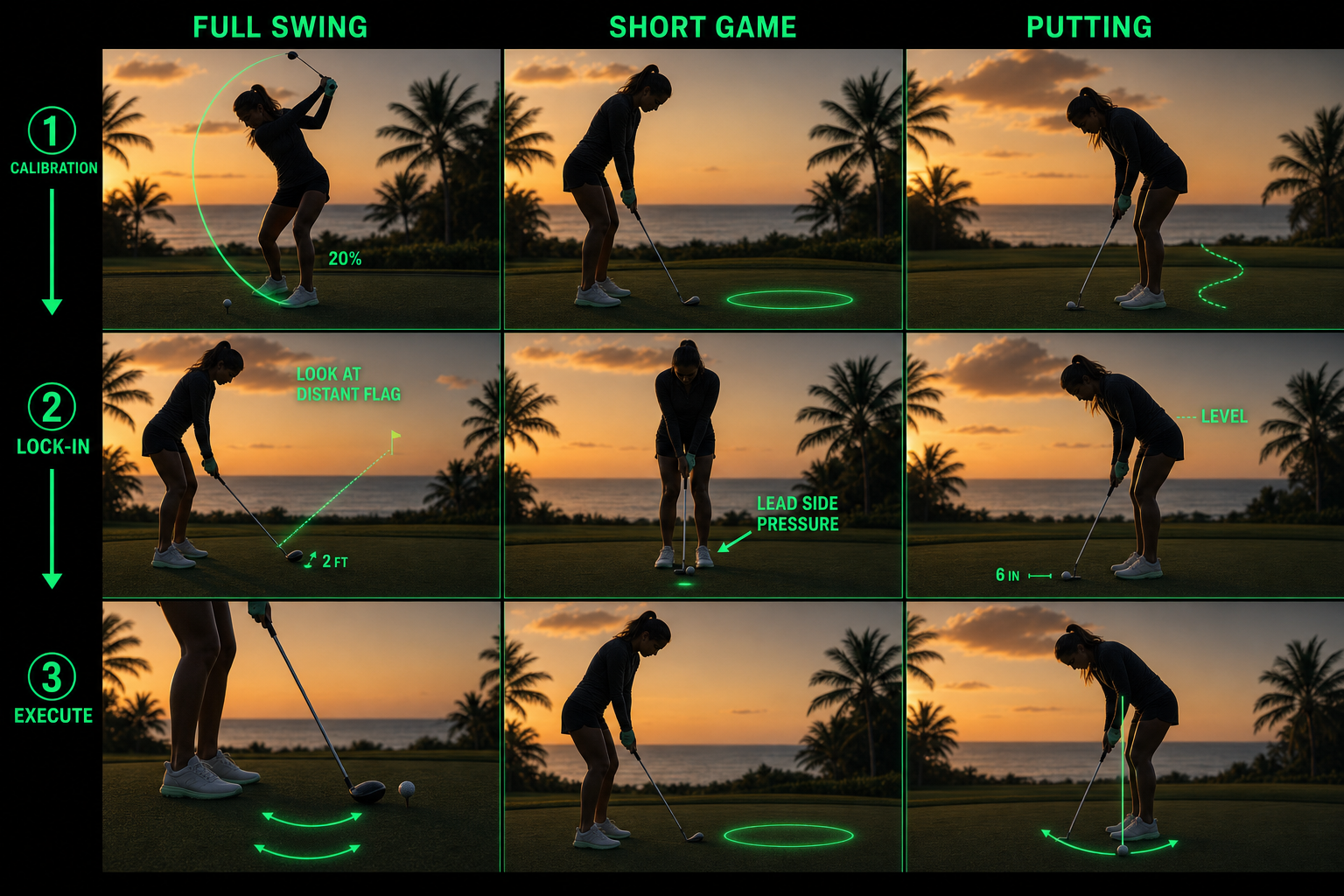
The Full Swing
Delivery rules come from the Full Swing Blueprint. Pre-shot programming protects GRF, Elbow Plane shallowing, and J-Curve release under pressure.
| Phase | Objective | Execution |
|---|---|---|
| 1 — Calibration | Map today's geometry behind the ball | One slow practice swing (~20% speed); feel shallowing, lead-side pressure, handle path |
| 2 — Lock-in | External start-line focus | Intermediate target ~2 feet ahead on start line; square leading edge; build stance around face |
| 3 — Execute | Trust trained geometry | Micro-motion; one look at target; eyes to ball; takeaway immediately — do not steer |
Burning focus on rehearsal swings before the real shot trains a different context than tournament execution. One calibration swing at ~20%, then lock-in.
The Short Game
Delivery rules come from the Short Game Blueprint: bounce skim → passive release → trajectory window → carry Level → landing spot. Shot-type routing: Short Game Shot Library.
| Phase | Objective | Execution |
|---|---|---|
| 1 — Calibration | Program setup before motion | Behind ball: call lob or checker window; assign landing spot; read lie |
| 2 — Lock-in | Face and pressure locked at address | Square leading edge to intermediate target; narrow stance, extra knee flex, ~55% lead-foot pressure; ball position sets window |
| 3 — Execute | External turf interaction | Micro-motion; focus on landing spot or hollow thump — not wrist hold or hinge maintenance |
Trajectory is locked at address—not invented in motion. See Trajectory Control — Pre-Shot Lock.

Putting
Delivery rules come from the Putting Blueprint: pendulum stillness → face at impact → speed Level → read loop.
| Phase | Objective | Execution |
|---|---|---|
| 1 — Calibration | Read and pace before address | Straddle line for slope value; on lag putts, pace distance behind ball — see Lag Putting |
| 2 — Lock-in | Face, Level, and line committed | Intermediate target ~6 inches ahead; square face; lock Level 1–3 and tempo before takeaway |
| 3 — Execute | Planar pendulum delivery | Micro-motion; roll over intermediate coordinate — head still through roll (pendulum) |
Speed is programmed before motion, not punched at impact.
Compressed Variants
Some situations compress the loop without skipping external focus:
Short Putts (Make Zone)
For putts inside the make zone (~3 feet), run the compressed routine:
- One look — confirm break only if visible; assign slope value when needed
- Intermediate target — 6-inch mark on start line
- Level 1 stroke — short backswing, constant tempo
- Execute — external focus on gate or intermediate target, not the hole
Multiple looks and re-aims on a 2-footer are doubt, not precision. Trust the read, lock the intermediate target, and go.
Lag Putts (25–50 Feet)
Long putts prioritize leave zone over holing out:
- Pace behind the ball — map distance to calibrated Level (Lag Putting)
- Lock Level and line — intermediate target on start line; commit to 12–18 inches past the hole
- Execute — pendulum stroke; no mid-stroke speed calculation
Bridging Range and Course
Category-specific pre-shot rules only transfer when the same loop runs on the range. Transfer Protocol Phase 3 and on-course play require:
- calibration or programming step behind the ball
- intermediate target / landing spot / Level lock
- full execute phase with micro-motion
If random range reps feel easy but the first tee feels foreign, the routine was skipped on the range. Add the full loop before declaring transfer success.
Read next: Recovery & Reset Protocol — what to do after a mishit without stacking swing thoughts.
The Cheatcode for your Game