External vs. Internal Focus: Cognitive Optimization
Swinging while actively monitoring multiple mechanical directives creates cognitive overload: timing breaks down, speed drops, and contact becomes erratic.
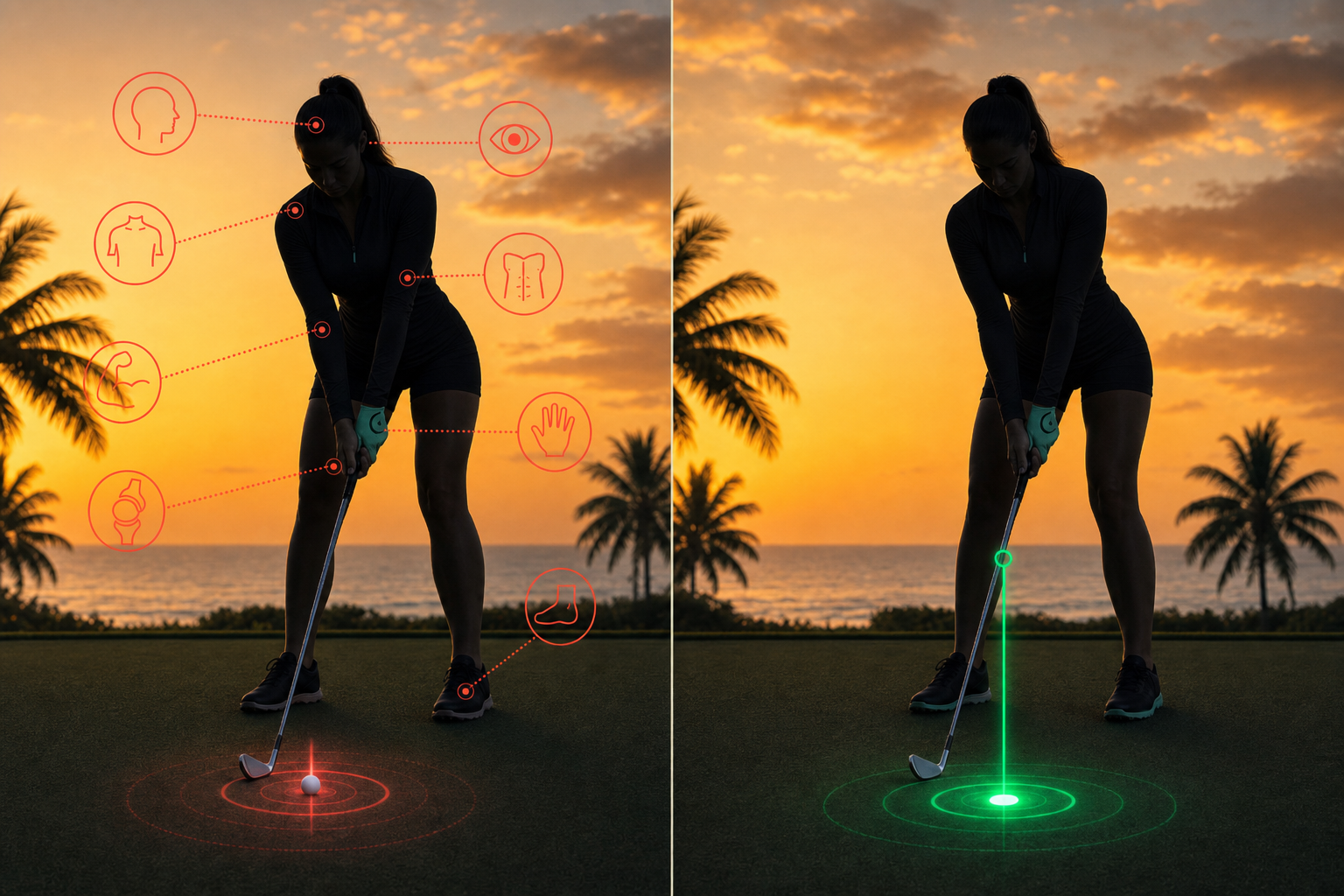
Final Boss Golf aligns practice with motor-learning research: during high-speed movement, internal focus (body-part commands) adds neurological latency and disrupts kinematic sequencing. External focus (targets, clubhead paths, turf interaction) unlocks self-organization.
The Internal Focus Movement Fault
Traditional instruction often feeds internal cues:
- "Keep the lead arm straight."
- "Tuck the trail elbow."
- "Fire the hips."
In a downswing that lasts roughly a quarter second, the conscious system cannot pilot those levers in real time. The result is disconnected, jerky motion.
If the last thought before takeaway is an anatomical instruction, latency rises. Internal focus throttles speed and blocks shallowing into the delivery corridor.
External Self-Organization
External focus projects attention onto the environment, the club, or the intended outcome. Assign a clear external task and the nervous system calculates efficient 3D geometry to achieve it.
Elite throwers do not micromanage elbow flexion—they lock onto the target and execute. Golf benefits from the same external targeting approach.
Practice vs. Course
The same player uses different attention modes in different contexts:
| Context | Focus mode | What to attend to |
|---|---|---|
| Range calibration (10% speed, freeze frames) | Constraint / process | Physical obstacles — constraint-led practice |
| Range Phase 3 / random | External outcome | Intermediate target, landing spot, Level call — plus full Pre-Shot Loop |
| On course | External outcome only | One delivery rule per shot — never body-part checklist |
Constraints teach geometry on the range; external targets deploy that geometry under pressure. See Transfer Protocol for the graduation path.
Recalibrating Cues
| Legacy internal cue | External tactical correction |
|---|---|
| "Shift weight to lead foot" | "Crush the turf" — drive vertical GRF into the lead side |
| "Swing from the inside" | "Avoid the constraint" — ceiling / exit gate stations on range; spike visualization on course |
| "Roll wrists through impact" | "Whip the clubhead through the exit gate" — J-Curve outcome |
| "Hold the hinge" | "Skim over the tee" / hollow thump — Geometry of Bounce, passive release |
| "Keep wrists quiet" (putting) | "Roll over the intermediate target" — Face Angle vs. Path |
| "Hit it harder" (putting) | "Finish 12 inches past the hole" — Speed Programming Level call |
Category-specific loop variants: Pre-Shot by Swing Category.
Recovery After a Mishit
When a shot goes wrong on course:
- Do not stack internal fixes on the next tee — one external rule only
- Run the full Pre-Shot Loop — same rhythm as before the mishit
- Save calibration for the range — open Faults & Fixes and The Practice Plan after the round
Full reset sequence: Recovery & Reset Protocol.
On course without training aids: imagine driving a spike into the back-inside quadrant of the ball. The objective is to hammer that point with the club mass. The body tends to shallow, compress, and deliver without wrist rescue.
The Cheatcode for your Game