Course Management & Transfer: Environmental Execution
The practice-facility movement fault is common: clean mechanics on the mat, breakdown on the first tee. Controlled environments are too predictable.
Transfer Protocol is the install OS — block → random → on-course, exit criteria, and when a pattern graduates. This page is the player-facing session designer — how to structure random reps, pressure games, surfaces, and test rounds so transfer sticks. Read Transfer Protocol for graduation rules; use this page to build the sessions.
Trains
- Transfer Protocol — block / random / on-course modes and exit criteria
- Practicing by Swing Category — Play It variation by Full Swing, Short Game, Putting
- Pre-Shot Loop + Pre-Shot by Swing Category — routine on every random rep and on-course shot
- Recovery & Reset Protocol — mishit behavior under pressure
Prerequisite: pattern clears block mode (8/10 constraint at 70%) before random or on-course transfer — see Transfer Protocol Step 1.
Block Practice Movement Fault
Firing the same 7-iron to the same target fifty times creates a short-term rhythm—not deep learning.
- the brain stops solving the movement problem and automates repetition
- on course, lie, club, and target change every shot
- new mechanics fail when retrieval effort was never trained
Flat mats forgive heavy strikes (club bounces into the ball). On grass, the same delivery chunks. Vary lies and surfaces so compression feedback stays honest — see Surface & Lie Protocol below.
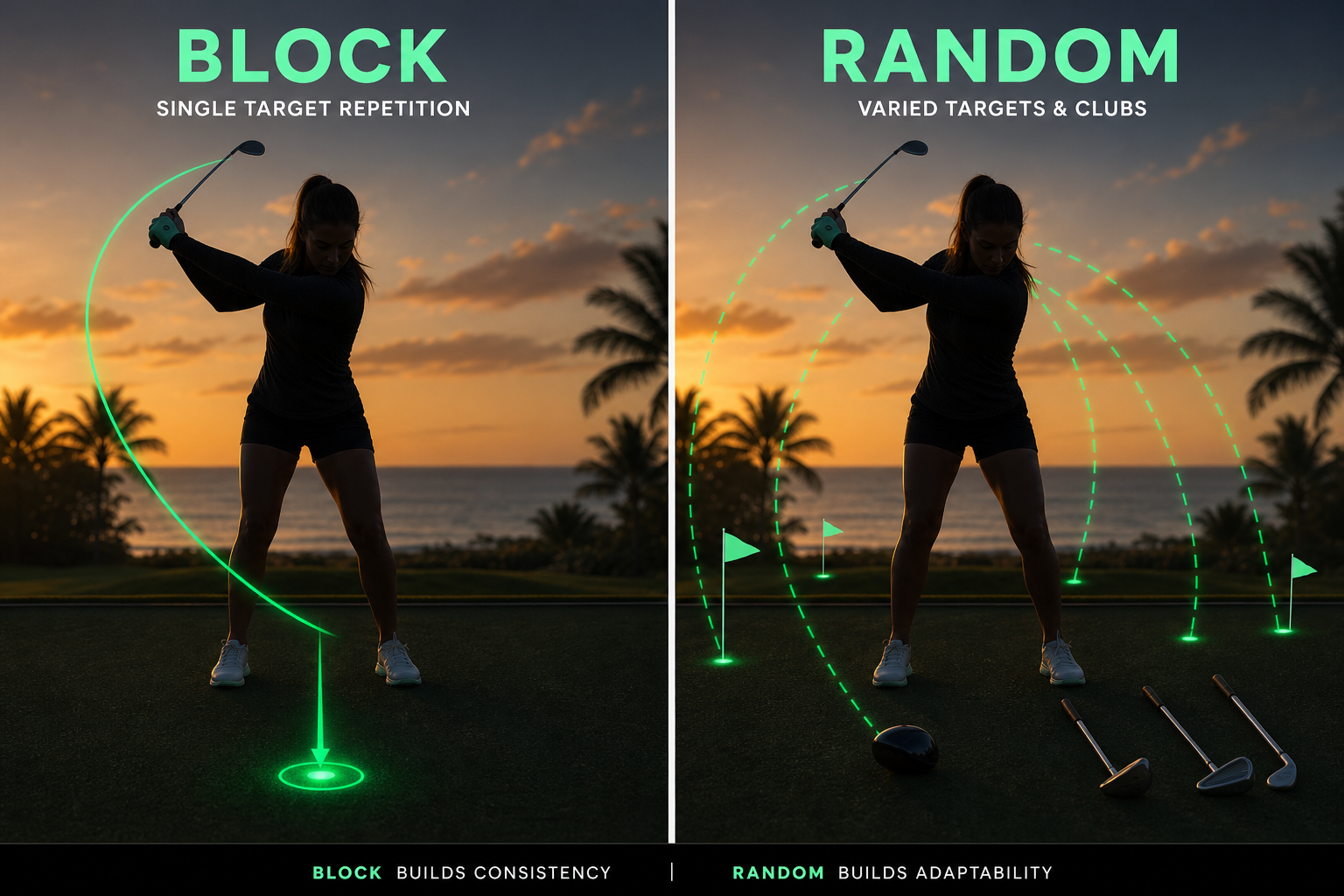
Random Practice by Swing Category
Random mode is Transfer Protocol Play It expanded. Variation is the constraint — but what varies depends on swing category. Full table in Practicing by Swing Category.
| Category | Change every rep | Play It success metric (not outcome) |
|---|---|---|
| Full Swing | Target + club every 3–5 reps; lie when available | Constraint cleared; delivery rule held |
| Short Game | Lie + trajectory window + landing spot | Skim quality + carry Level accuracy |
| Putting | Distance + break call; full read loop | Gate pass or leave-zone finish |
Universal random rules:
- Target shifting — never hit two balls to the same coordinate
- Club rotation (full swing) — driver → 6-iron → wedge; no false rhythm from one shaft length
- Trajectory modifiers — high/low, draw/fade when pattern is stable (Flat Plane vs. Real Motion)
- Full Pre-Shot Loop on every rep — category variants in Pre-Shot by Swing Category
If shallowing holds on rep 1 but fails on rep 7 with a new target, the pattern is not installed—it is block-dependent. Random practice exposes what block practice hides.

Surface & Lie Protocol
Honest feedback requires the right surface for the session goal:
| Surface / lie | Best for | Limitation |
|---|---|---|
| Range mat | Path work, shallowing corridors, constraint stations | Forgives fat strikes; hides low-point errors |
| Grass range | Compression, low-point, authentic friction | Preferred for Prove It+ and all transfer work |
| Tight lie / fairway | Bounce skim, short-game random | Punishes dig; use in Short Game Play It |
| Rough / uneven | Trouble-shot adaptations, flyer awareness | Full-swing GRF throttled ~80% on extreme slopes |
Schedule at least one grass session per week during transfer blocks. Saturday weekly routing uses on-course or combined-random days for live context.
Pressure Simulation
Pressure elevates heart rate and tension, which can freeze a passive release. Add consequences after random mode is stable — not before block clears.
Pressure Games Catalog
| Game | Setup | What it trains |
|---|---|---|
| Fairway streak | Pick a fairway target; five in a row or reset the set | Start-line + routine under mild consequence |
| Make-or-reset | Short putt or chip — miss one, restart set from zero | Make-zone / gate stability under load |
| One pattern, nine holes | One delivery rule only for nine holes — score process | Transfer Protocol Step 3 |
| Hazard visualization | Before each shot, name water left / OB right / firm green | External focus under cognitive load |
| Terminal execution test | End session: one ball on live grass, high-stakes tee shot, full routine, single attempt | Pass/fail transfer check |
Every pressure rep requires:
- full Pre-Shot Loop — not an abbreviated version
- after a mishit, Recovery & Reset on the next shot — one external rule only

End a transfer block with one ball on live grass. Simulate a high-stakes tee shot. Full routine, single attempt. If geometry holds under that constraint, transfer is progressing.
On-Course Transfer Rules
On-course transfer is not “play 18 and hope.” Deliberate scoring reps with the same external focus used on the range:
- One pattern per round—or per nine — not three swing changes at once (Transfer Protocol)
- Score process, not outcome — constraint cleared or routine completed = success, even on a mishit
- Diagnose reversion — old fault returns under pressure → drop back to random mode on the range; do not add swing thoughts on course
- Tactical decisions — landing spots, lie reads, leave zones live in On-Course Tactics
Ready for On-Course? (Exit Criteria)
A pattern is installed when all three conditions hold across two consecutive sessions — full checklist in Transfer Protocol:
| Criterion | Standard |
|---|---|
| Random mode | 7 of 10 reps hold delivery rule across varied targets/clubs at full tempo |
| External focus | No conscious body-part focus — intermediate target, landing spot, or Level only |
| Recovery | After one mishit, next rep returns to pattern via Recovery & Reset |
If criteria fail on session two, return to block mode at 30% for 20 reps — not full-speed troubleshooting on course.
Grooving This Pattern
Install transfer behavior across three sessions — not 50 swing reps:
Session 1: Block Random Bridge
- Practice Speed: ~30–70% of your max · ball on — change target every 5 reps
- Objective: Pattern holds when aim changes — add full Pre-Shot Loop during Play It (20 reps) of 50-Rep Blueprint
- Surface: Grass when available
Session 2: Full Random + Pressure
- Practice Speed: Up to 100% of your max · game speed — new target/club/lie every rep; one pressure game from catalog above
- Objective: 7/10 delivery-rule holds; routine timing stable (8–12 s)
- Check: Mishit recovery uses four-step reset — not internal fix stack
Session 3: On-Course Test
- Mode: Nine holes or combined random on course — one pattern only
- Objective: Process score — routine completed and external focus intact
- Pass: Terminal execution test or first-tee feel matches range Play It
Trying to install GRF, J-Curve, and bounce geometry in the same round guarantees reversion. One pattern per transfer block.
Read next: On-Course Tactics — decision engine before setup (landing spots, lies, leave zones).
The Cheatcode for your Game